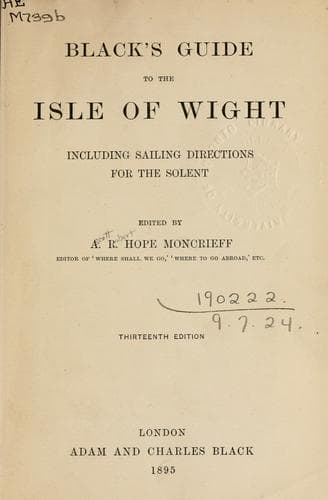
Isle of WightMoncrieff, A. R. Hope (Ascott Robert Hope)
History
Isle of Wight
Moncrieff, A. R. Hope (Ascott Robert Hope)
Isle of Wight (England) -- Description and travel
irregular architecture, wilful roads, and provoking impasses are at
least in harmony with each other.
Let us see how it strikes a stranger--Mr W. D. Howells, to wit--on a
recent visit.
The lovely little town, which is like an English water-colour, for
the rich, soft blur of its greys and blues and greens, has a sea at
its feet of an almost Bermudian variety of rainbow tints, and a
milky horizon all its own, with the sails of fishing-boats drowning
in it like moths that had got into the milk. The streets rise in
amphitheatrical terraces from the shore, and where they cease to
have the liveliness of watering-place shops, they have the
domesticity of residential hotels and summer boarding-houses, and
private villas set in depths of myrtle and holly and oleander and
laurel: some of the better-looking houses were thatched, perhaps to
satisfy a sentiment for rusticity in the summer boarder or tenant.
But this appreciative stranger is a little at sea in freely dashing into
his sketch a background of “seats and parks of nobility and gentry,”
which seems somewhat of an American exaggeration for the villaed skirts
of Ventnor. The most lordly “seat” about Ventnor is Steephill Castle, at
the west end, from the tower of which flaunts his own Stars and Stripes
to proclaim it the home of a compatriot who must have reason to chuckle,
as he does in a volume of memoirs, that slow, simple, honest John Bull
now wakes up to let himself be exploited by Transatlantic enterprise.
This gentleman’s daughter was the late popular novelist “John Oliver
Hobbes,” who latterly lived much here, or in the neighbourhood. The
modern castle, that has housed an empress in its time, took the place of
a cottage of gentility built by Hans Stanley, George III.’s Governor of
the Island. It formerly belonged to the Hamborough family, whose heir
met with his death in a painful way, that gave rise to what was known
as the Ardlamont murder case.
The trustees of this family have lately been at loggerheads with the
Ventnor people as to enclosing the links by the shore. Part of the cliff
here, however, has been acquired as a prettily unconventional public
park, laid out with playing greens beneath its leafy mazes and airy
walks. At this end, opposite the west gate of the park, is the station
of the mid-island line, distinguished as “Ventnor Town,” whereas
“Ventnor” station of the older east coast rail stands so high above the
sea that access to it suggests the “stations” of a pilgrimage. The last
time I was in Ventnor, I had the pleasure of being able to assist some
countrywomen of Mr Howell’s whom I found fluttering in breathless doubt
between those two confusing goals, that ought to be joined by some kind
of mountain railway.
Public-domain text, read in full here on John Shaqi.
Reviews
Reviews
No reviews yet
Be the first to share your thoughts on this work.
Join the Discussion
Join the discussion
Sign in to leave a comment or review.
Sign InorCreate an account