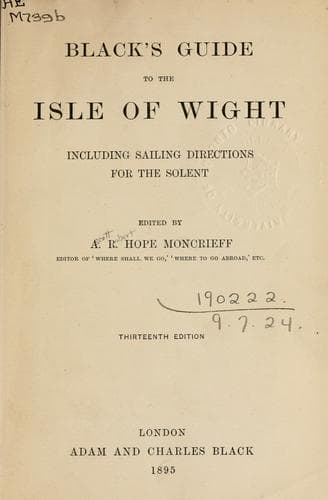
Isle of WightMoncrieff, A. R. Hope (Ascott Robert Hope)
History
Isle of Wight
Moncrieff, A. R. Hope (Ascott Robert Hope)
Isle of Wight (England) -- Description and travel
One advantage of having attained the upper station, is that here one is
half-way up the steep bank rising behind Ventnor to be the highest point
of the Island, nearly 800 feet. This down bears the name of St Boniface,
in honour of whom passing ships used to lower their topsails. The ridge
is reached by chalky paths from a road near the station, and from other
approaches at the top of the town; and however stuffy the air may be
below, the perspiring climber will not fail to find invigoration on the
open crest. For goal of the ascent, there is a wishing-well, as to which
old tradition has it that, if you reach the spot, Orpheus-like, without
casting a backward glance, the wish you may form while drinking of its
welcome spring will speedily be fulfilled. Certainly no finer view could
be wished for than one gains from the summit and along a wide stretch of
rambles on either hand. Holding on round a horse-shoe hollow, one may
turn down on the right to Shanklin; or, in the other direction, crossing
the rail and road to Ryde at Wroxall, pass over to the heights of
Appuldurcombe, where the Worsley monument makes a beacon. Hence another
lofty sweep brings one back to Ventnor by Week Down and Rew Down, used
as a golf ground, which must try the strength of elderly devotees on
their preliminary ascent to the clubhouse, standing out like an Alpine
chapel.
The stiff-kneed pilgrim who has not heart for such arduosities, may
follow the road along the face of St Boniface Down, or the sea-walk
below, to Bonchurch, that choice and lovely east-end of Ventnor,
clustered round a pond, overhung by a rich bank of foliage. The mildness
of the climate is attested by huge arbutus growths, recalling those of
Killarney, by fuchsias like trees, with trunks as thick as a strong
man’s wrist, and by scarlet geraniums of such exuberance that a single
plant will cover several square yards of wall in front of a house. This
one fact, more than any word-painting, gives an idea of the way in which
Bonchurch, and indeed most parts of Ventnor, are embowered by foliage.
In all sorts of odd nooks, either nestling against the steep wall of the
Undercliff, or hiding away in its leafy hollows, perch the picturesque
cottages and handsome villas that have attracted only too many
neighbours. The road is much shut in between walls of private grounds,
within which are enclosed some of the finest spots, such as the “Pulpit
Rock,” a projecting mass of sandstone marked by a cross, and another
known as the “Flagstaff Rock.”
Public-domain text, read in full here on John Shaqi.
Reviews
Reviews
No reviews yet
Be the first to share your thoughts on this work.
Join the Discussion
Join the discussion
Sign in to leave a comment or review.
Sign InorCreate an account