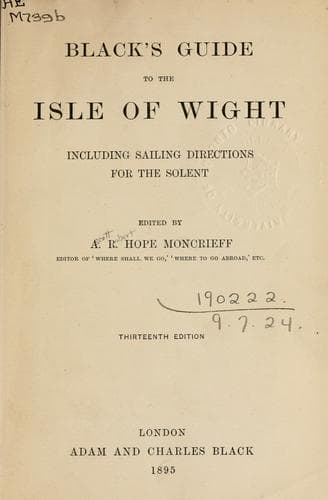
Isle of WightMoncrieff, A. R. Hope (Ascott Robert Hope)
History
Isle of Wight
Moncrieff, A. R. Hope (Ascott Robert Hope)
Isle of Wight (England) -- Description and travel
Next came northern pirates, who would be not so much interested in the
mild climate of the Island, as in the creeks and landing-places of its
shores. They, too, have left relics of their occupation, chiefly in the
graves furnished with utensils and ornaments of heathen life. But when
Jutes and Saxons had destroyed the Roman civilisation, they fell under
another influence spread from the Mediterranean. Bishop Wilfred of
Selsey has the credit of planting, or replanting, Christianity in the
Island. It could hardly have taken deep root, when the Danes came to
ravage the monastic settlements. For a time the Cross and the Raven must
have struggled for mastery here like the encountering tides of Solent,
till that new wave of invaders ebbed back or was absorbed into the old
one; then again the Island became overflowed by a fresh storm of
conquest. If we consider from how many races, in three continents, the
Roman soldiery were drawn, and how the northmen must have mixed their
blood with that of a miscellany of captives, it is clear that, when
overrun by a fresh cross-breed between Gauls and Vikings, the population
of our islands, large and small, could in many parts have been no very
pure stock, such as is fondly imagined by the pride of modern
Pan-Celticism and Anglo-Saxondom.
In Norman England, the Wight soon emerges into note. King William
visited it to seize his ambitious brother Odo at Carisbrooke. The
fortress there was enlarged by William Fitz-Osborne, to whom the Island
had been granted, and who salved his conscience for any high-handed acts
of conquest by giving six churches to the Norman Abbey of Lira, the
beginning of a close connection with that continental foundation. His
son lost this lordship through treason; then for two centuries it was in
the hands of the Redvers, Earls of Devon, who grew to be
quasi-independent princes. The last of their line was Isabella de
Fortibus, holding her head high as Lady of the Island till on her
deathbed, her children being dead, she sold her rights to Edward I. for
6000 marks.
Henceforth this dependency was governed for the crown through
lieutenants at first known as Wardens, an office held by great names
like Edward III. in his childhood, the Earl of Salisbury, the Duke of
York, the Duke of Gloucester, Anthony Woodvile, Earl of Rivers; and in
such hands more than once showing a tendency to become hereditary. Their
post was no sinecure, for at this period the Island made a striking
point for French raids that have left their mark on its towns. Not that
the raiding was all on one side. The islanders long remembered ruefully
how Sir Edward Woodvile led the flower of their manhood into France,
when of more than four hundred fighters only one boy escaped to tell the
tale of their destruction, that seems to have been wrought by French
artillery, turning the tables on the English long-bow.
Public-domain text, read in full here on John Shaqi.
Reviews
Reviews
No reviews yet
Be the first to share your thoughts on this work.
Join the Discussion
Join the discussion
Sign in to leave a comment or review.
Sign InorCreate an account