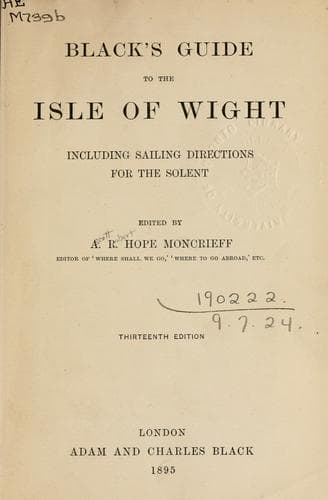
Isle of WightMoncrieff, A. R. Hope (Ascott Robert Hope)
History
Isle of Wight
Moncrieff, A. R. Hope (Ascott Robert Hope)
Isle of Wight (England) -- Description and travel
clearly ascertained proportion of them live to assert that the scenery
of the Island and the happiness of the marriage state have alike been
more or less overrated. I give these figures for what they are worth,
along with the unquestioned fact that the Isle of Wight belongs, in a
manner, to the county of Hants, but has a County Council of its own, and
in general maintains a very insular attitude of independence, modelled
on the proud bearing of Great Britain towards mere continental
countries.
Facts and figures somewhat fail one who comes to lecture on the original
population of this Island. The opinion fondly held in a certain section
of “smart” society, that the lawn of the Squadron at Cowes represents
the Garden of Eden, seems to rest upon no critical authority; indeed
Adam and Eve, as owners of no yacht, would not be qualified for
admission to this select enclosure. With some confidence we may state
that the Island was first peopled by aborigines enjoying no protection
against kidnappers and conquerors, who themselves found it difficult in
the long run to blackball undesirable aliens, as Australia and New
Zealand try to do under the protection of fleets steaming forth from the
Solent. There are well-marked indications of invasion by a Belgic tribe
from the mainland, to make this a “free” state, as early prelude to King
Leopold’s civilisation of the Congo. But we may pass lightly over the
Celtic period, with place-names and pit-dwellings as its records, to
come into clearer historic light with Vespasian’s conquest in A.D. 43.
For more than three centuries, with apparently one episode of revolt,
the Romans held Vectis, as they called it; and it has been maintained,
though this goes not unquestioned, that here was their _Ictis_ port, at
which they shipped the tin drawn from the mines of Cornwall. If so, the
island described by Diodorus Siculus was then an island only at high
water. The clearest marks left by Rome are the remains of villas
unearthed at different points, at least one of which indicates a tenant
of luxurious habits and tastes. We can understand how Italian exiles
might prefer this station to one in the bleak wilds of Derbyshire or
Northumberland, as an Anglo-Indian official of to-day thinks himself
lucky to have his compound at Poona or Bangalore, if not at Mahableshwar
or Simla. The Brading villa, indeed, like those of Bignor in Sussex and
Brough in Norfolk, seems rather to have been the settled home of a rich
nobleman, Roman or Romanised British, who had perhaps strong opinions as
to the way in which Rome neglected the wishes and interests of her
colonies. These remains were unearthed only in living memory, so that
writers of a century ago ignore such traces of Roman occupation.
Public-domain text, read in full here on John Shaqi.
Reviews
Reviews
No reviews yet
Be the first to share your thoughts on this work.
Join the Discussion
Join the discussion
Sign in to leave a comment or review.
Sign InorCreate an account