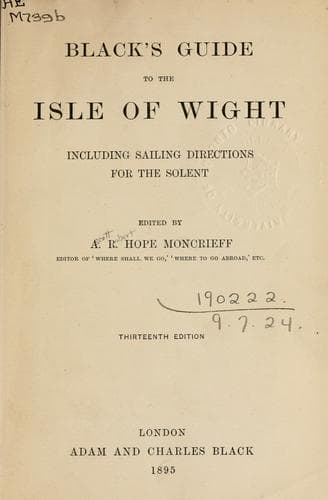
Isle of WightMoncrieff, A. R. Hope (Ascott Robert Hope)
History
Isle of Wight
Moncrieff, A. R. Hope (Ascott Robert Hope)
Isle of Wight (England) -- Description and travel
The goal of Black’s party was the Sandrock Hotel, prettily situated by
the roadside at Undercliff Niton, which has a chalybeate spring, and
near it some local worthy thought desirable to erect a small shrine to
the memory of Shakespeare, anticipating the more pretentious monument by
which he is now to be glorified in London. From this seaside outpost
turns off the way to the inland village of Niton, lying behind in a
break of the chalk heights. It has been distinguished from Knighton by
the sobriquet of Crab Niton, “a distinction which the inhabitants do not
much relish, and therefore it will be impolitic to employ it,” as a
venerable guide-book very prudently suggests; and Knighton being
nowadays little more than a name, strangers will find no inconvenience
in taking that hint. The place boasts at least one sojourner of note, as
we learn from the
[Illustration: THE UNDERCLIFF NEAR VENTNOR]
tomb of Edward Edwards, leader of the Free Public Library movement that
has now so many monuments all over the country.
The parish of Niton is a large one, containing the head springs of the
Medina and of the eastern Yar, which the well-greaved adventurer might
hence try to track across the Island to their not very distant mouths.
More otiose travellers will find a road passing under St Catherine’s
Down for Newport and the central parts. From the sturdy church tower
with its low spire, a lane leads up to the top of the Down, whence we
could take a wide view of our wanderings, backwards and forwards. And
here, since we are almost at the end of the Undercliff, let us break off
to survey the longer but less famed stretch of this coast, westwards,
under its more comprehensive title.
THE BACK OF THE ISLAND
Our Pisgah for this stage is St Catherine’s Down, once held the highest
point of the Island, but now dethroned, like Ben Macdhui, in favour of
the Ben Nevis of St Boniface. It appears that in Georgian days Week Down
was charged with hiding Shanklin Down from the view of St Catherine’s,
as is no longer the case, the moral being that one or other of these
heights has been raised or depressed, as may well have happened to
superstructures upon so slippery foundation. In such a question of
measurements, at all events, “the self-styled science of the so-called
nineteenth century” with its more elaborate observations, gives a surer
title to eminence. But St Catherine’s is only a few feet lower than the
ridge above Ventnor; and from it, too, a fine prospect may be had,
ranging over the Isle of Wight to the heights of the mainland, and
across the Channel to the French coast in clear weather.
Public-domain text, read in full here on John Shaqi.
Reviews
Reviews
No reviews yet
Be the first to share your thoughts on this work.
Join the Discussion
Join the discussion
Sign in to leave a comment or review.
Sign InorCreate an account