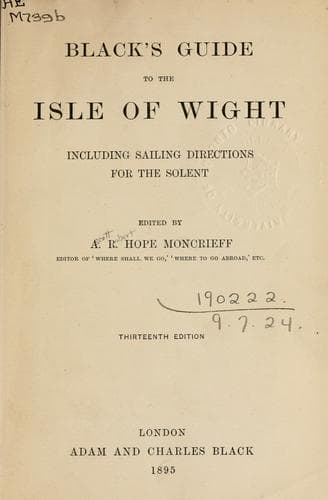
Isle of WightMoncrieff, A. R. Hope (Ascott Robert Hope)
History
Isle of Wight
Moncrieff, A. R. Hope (Ascott Robert Hope)
Isle of Wight (England) -- Description and travel
This broad and steep block of down is well provided with landmarks. On
the inland side a tall pillar was erected by a Russian merchant, in
honour of the Czar Alexander’s visit to England after the fall of
Napoleon; which monument a later generation very inappropriately adorned
with a memorial of our soldiers fallen in the Crimean War. On the top
are the restored remains of a chapel, where in old days a hermit-priest
made himself truly useful by keeping a light burning to warn mariners
off this stormy coast, and chanting prayers for their safety. A less
pious legend attributes the building of the old beacon here to a layman
amerced in such a penalty for having stored his cellars with wine sold
him by shipwrecked sailors, a class not very scrupulous as to owner’s
rights--
Full many a draught of wine had he y-draw
From Bourdeaux-ward, while that the chapmen sleep:
Of nicé conscience took he no keep.
Hard by is a later ruin to show how a lighthouse was designed in the
eighteenth century, but a practical age gave up the attempt to rear a
pharos on this cloudy height. Experience since then has gone to show
that a lighthouse serves its end better at the water’s edge than on
commanding cliffs like Beachy Head and Portland Point, from both of
which the old beacons have lately been moved to a lower level.
St Catherine’s Lighthouse stands on the point of that ilk, the most
southerly projection of the Island, where it has Lloyd’s signal station
for neighbour. Its recently intensified electric light is said to be the
most powerful in the world, every few seconds flashing over the sea a
beam of concentrated glare equal to millions of candles. It is also
equipped with a fog-horn, whose hoarse note of warning resounds for
miles, not altogether to the satisfaction of neighbours safe on land.
Yet they may take comfort to think how this screech is more fearsomely
disquieting when heard at sea. I once had such a note ringing in my ears
for two days together running through a chill fog off Newfoundland, with
icebergs about us that could be felt but not seen. Our boat was one of
the few that have crushed into an iceberg and crawled to land with the
tale; then to keep us cheerful we had on board a survivor of that
adventure, the perils whereof it pleased him to depict as looming
through a somewhat befogged imagination.
Public-domain text, read in full here on John Shaqi.
Reviews
Reviews
No reviews yet
Be the first to share your thoughts on this work.
Join the Discussion
Join the discussion
Sign in to leave a comment or review.
Sign InorCreate an account