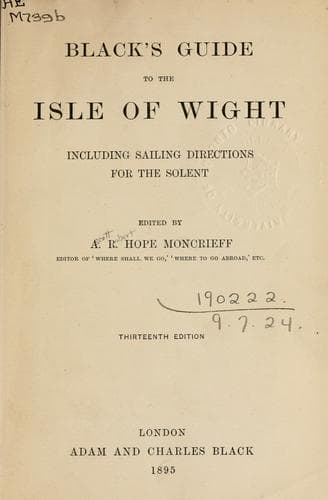
Isle of WightMoncrieff, A. R. Hope (Ascott Robert Hope)
History
Isle of Wight
Moncrieff, A. R. Hope (Ascott Robert Hope)
Isle of Wight (England) -- Description and travel
Another of our fellow-passengers was an American gentleman, who in
Europe had been qualifying himself to come out as an opera tenor. He was
coy of giving us a specimen of his talent, till one night we persuaded
him to begin _Ah, che la morte!_ But at once the officer of the watch
stepped up to silence him, explaining that his singing might drown the
sound of fog-horns. The vocalist was much offended at his organ being
coupled with a fog-horn; and I fear I gave him fresh offence by
suggesting “Signor Fogorno” as a suitable _nom de guerre_, when he
consulted me as to Italianising his rather commonplace patronymic. But
that careful officer was right, if the story be true that a German liner
ran ashore on the back of the Island because her own brass band deafened
her to the warning note that surely should have drowned all sweeter
sounds. And if our insulted tenor had known it, this artificial organ
has a very old theatrical connection, for _persona_ seems the earliest
form of such a sounding contrivance, originally a megaphonic mouthpiece
fitted to a mask which, as one of the classical stage properties, came
to denote the personage thus represented; and in time the name gained
respectability as the person or parson of a parish, who more or less
loudly warned his convoy of souls from the rocks and shoals of
ill-doing.
A different kind of signal would be keenly watched for in days when the
storm of Napoleon’s invasion was expected to burst upon our shores; and
on all prominent points beacons were kept ready to spread the alarm of
the enemy’s approach. The Isle of Wight was fully on the alert,
remembering how often it had been a vulnerable point in mail-clad wars
with France, though one would think that the bugbear, Boney, knew his
business too well to seek a difficult landing in an island, beyond which
he would be brought up by a dangerous channel, a strong arsenal, and a
naval rendezvous. It is said that the signalman at St Catherine’s,
probably having drunk the king’s health too freely in smuggled spirits,
mistook some fishing-boats for a French fleet, and lighted his beacon to
set men mustering in arms and women and children flying for refuge to
Newport. Sir Walter Scott tells us how the same sort of blunder stirred
a great part of Scotland. But on one side of the Island the scare did
not spread far, since the watcher at Freshwater very sensibly reasoned
that the wind then blowing would keep this coast clear of hostile ships,
and forbore to pass on the alarm.
Public-domain text, read in full here on John Shaqi.
Reviews
Reviews
No reviews yet
Be the first to share your thoughts on this work.
Join the Discussion
Join the discussion
Sign in to leave a comment or review.
Sign InorCreate an account