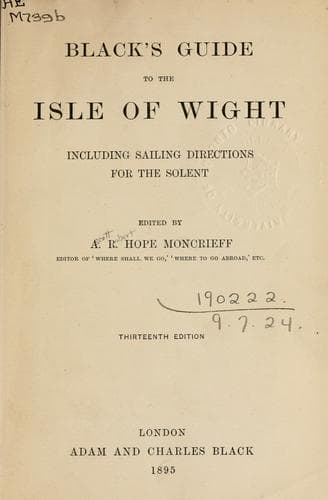
Isle of WightMoncrieff, A. R. Hope (Ascott Robert Hope)
History
Isle of Wight
Moncrieff, A. R. Hope (Ascott Robert Hope)
Isle of Wight (England) -- Description and travel
Under them the Island was happy enough to have little history, though it
had again to be on its guard when Dutch admirals talked of sweeping the
English ships from the Channel. It saw William’s fleet sail by on the
way to Torbay; and two years later it seemed about to have from its
southern cliffs the spectacle of a hundred French sail engaging the
English and Dutch squadrons; but the scene of that encounter was shifted
to Beachy Head, where it ended in a manner not much dwelt upon in our
naval annals. Then the long struggle with Napoleon once more turned this
outpost of England into a camp. In the peaceful days that followed, the
governorship became a mere ceremonial function. The title, held by
Prince Henry of Battenberg, was passed on to his widow, the youngest
daughter of Queen Victoria, whose death at Osborne makes the last date
in this Island chronicle.
An insulated people naturally formed a race apart, speaking a marked
dialect, and cherishing a strong local feeling. Their situation, and the
once pressing need to stand on defence by land and sea, bred a sturdy
race, whose vigour in old days was apt to run to such enterprising ways
of life as piracy, wrecking, and smuggling; but all that may be
forgotten like scandal about Queen Elizabeth. One evil of the islanders
keeping so much to themselves has been a stagnation of population, that
through intermarriage made for degeneracy. Sir John Oglander, the Stuart
worthy whose jottings on his contemporaries prove so amusing, says that
the Island once bore the reproach of not producing a good horse, a wise
man, or a pretty woman; but he hastens to add _Tempora mutant_; and on
the last head, the stranger can judge the calumny for himself. Hassell,
an eighteenth century tourist, remarks for his part on the beauty and
even elegance of the farmers’ daughters at Newport market, while of the
fathers he hints at grog-blossoms as a too common feature. The lately
published memoirs of Captain Elers treat the former point as matter of
notoriety. A certain boisterous pertness noted in the male youth of the
Island has been referred by sociologists to an absence of birch in its
flora. All ages have been noted for a clannishness that was once
disposed to look askance on such “overners” or “overers” as found their
way into the Wight, whose own stock we see to have sprung from
immigrants of different breeds. But here, as elsewhere, schools,
newspapers, and facilities of travel are fast rubbing down the
prejudices of parish patriotism.
Public-domain text, read in full here on John Shaqi.
Reviews
Reviews
No reviews yet
Be the first to share your thoughts on this work.
Join the Discussion
Join the discussion
Sign in to leave a comment or review.
Sign InorCreate an account