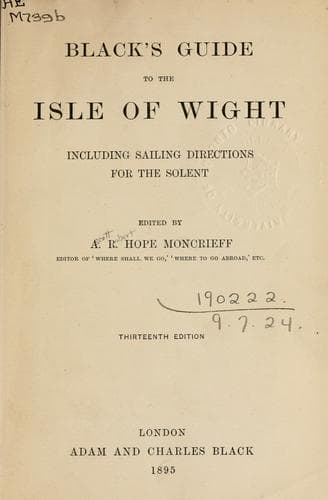
Isle of WightMoncrieff, A. R. Hope (Ascott Robert Hope)
History
Isle of Wight
Moncrieff, A. R. Hope (Ascott Robert Hope)
Isle of Wight (England) -- Description and travel
The upper class, indeed, is now largely made up of well-to-do strangers
drawn to the Island by its various amenities; while the sons of the soil
have laid aside suspicious dislike of the outsiders whom they know as
profitable guests. From pictorial cards, valentines, and such vulgar
documents, they appear to bear the nickname of Isle of Wight “Calves,”
which may be taken as a sub-species of the “Hampshire Hogs,” who suffer
such neighbourly satire as is shown in by-words like “Norfolk
Dumplings,” “Lincolnshire Yellow-bellies,” or “Wiltshire Moonrakers.”
Some strangers, however, at the height of the season, have been more
inclined to find for the natives a zoological similitude in the order of
_Raptores_. “I do not mean,” as a precise old gentleman once explained
to me of his landlady, “that she has feathers and claws like a bird; but
I assert that, in character and in disposition, she resembles a
vulture.” It is often, indeed, made evident to the meanest capacity that
the Island hosts belong to a long-billed family; but they perhaps as
often as not may be classed as overners, or referred to the hydra-like
form of polyzoic organism popularly known as a Company, Limited.
The soil is well cultivated, and many of the farms look thriving, though
the rank hedges and the flowers that colour some of the pastures, spread
a more pleasing view for an idle stranger than for a practical
cultivator. The Downs support flocks as well as golf clubs; the breed of
Island sheep was highly esteemed of old, where the climate makes for
early lambing. When some parts were overrun with “conies,” Sir E. Horsey
had the name of bringing in hares, which he paid for at the rate of a
lamb a-piece; but foxes and badgers have not crossed the Solent.
The coast folk carry on amphibious business, from oyster beds to
ship-chandling. Ship-building at Cowes, and cement-making on the Medina,
are the only large industries I know of. The chief trade seems to be in
tourists, who are taxed, tolled, and touted for at every turn by the
purveyors of entertainment for man and beast, the managers of
excursions, and the enclosers of natural curiosities. Visitors come from
far and near, the Island making a holiday resort for the townsfolk of
Portsmouth and Southampton, while among foreign tourists, it seems to
have a special attraction for Germans; and some of the American
travellers who “do” Europe in three weeks are known to spend as much as
several hours in scampering across to Ventnor.
Public-domain text, read in full here on John Shaqi.
Reviews
Reviews
No reviews yet
Be the first to share your thoughts on this work.
Join the Discussion
Join the discussion
Sign in to leave a comment or review.
Sign InorCreate an account