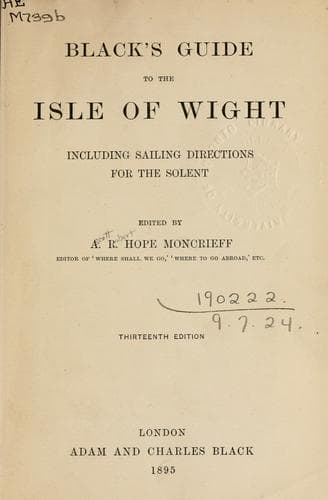
Isle of WightMoncrieff, A. R. Hope (Ascott Robert Hope)
History
Isle of Wight
Moncrieff, A. R. Hope (Ascott Robert Hope)
Isle of Wight (England) -- Description and travel
A good many visitors, however, come for a considerable time, delicate or
luxurious folk, lucky enough to be able to take advantage of a milder
climate in our uncertain winter or still more treacherous spring. One
must not indeed expect too much of any British climate. About Torquay,
the chief rival of Ventnor as a sheltered resort, a well-known novelist,
after living there through many winters, says bluntly that it is a
little less cold than the rest of England. Such places are apt to bid
for patronage by statistics of sunshine, temperature, and so forth,
which may prove bamboozling, not to say deceptive, when it is difficult
to tabulate the occurrence of trying extremes under the changes and
chances of our fickle sky. The best test of climate is its general
effect on vegetation; and it may be said with truth that the Isle of
Wight, on the whole, is two or three weeks ahead of inland districts of
our country. But it cannot claim to be such a halcyon spot as the
dream-world of another poet, who knew it well in all weathers.
The island-valley of Avilion,
Where falls not hail, or rain, or any snow,
Nor any wind blows loudly, but it lies
Deep-meadowed, happy, fair with orchard lawns
And bowery hollows crowned with summer sea.
There is snow here, sometimes, and rain pretty often; while wind makes
for the islanders as touchy a point as the title “Lady of Snows” for
Canada; but in fact, being an island, this nook must take the
consequences of such a situation, swept by breezes from all quarters,
especially from the south-west. The north and east sides of course are
more exposed to bracing winds, and their resorts, from Cowes to Sandown,
come into favour rather in the summer season, that fills the sails of
yachts and pleasure-boats, as well as greases the wheels of coaches
cruising upon land excursions. The “Back of the Island” is more stormed
upon by Atlantic gales, while one half of it, the famous Undercliff, is
so snugly shut in to the north, as to make a winter garden of myrtles,
fuchsias, arbutus, and still rarer evergreenery. Here, perhaps, it was
that a Miss Malaprop complained of this Island as not “embracing”
enough, and got advice to try then the Isle of Man.
Public-domain text, read in full here on John Shaqi.
Reviews
Reviews
No reviews yet
Be the first to share your thoughts on this work.
Join the Discussion
Join the discussion
Sign in to leave a comment or review.
Sign InorCreate an account