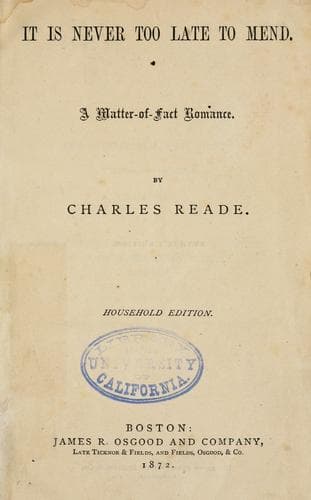
Great Britain -- Social conditions -- 19th century -- Fiction
Meadows took his foot out of the stirrup. Never leave an enemy behind
you, was one of his rules. “And why does the old heathen stay?” Meadows
asked himself; he clinched his teeth and vowed he would not leave the
village till George Fielding was on his way to Australia.
He sent his mare to the “Black Horse,” and strolled up the village;
then he showed the boy a shilling and said, “You be sure and run to the
public-house and let me know when George Fielding is going to start--I
should like to see the last of him.”
This was true!
CHAPTER III.
AND now passed over “The Grove” the heaviest hours it had ever known;
hours as weary as they were bitter to George Fielding. “The Grove”
was nothing to him now--in mind he was already separated from it; his
clothes were ready, he had nothing more to do, and he wished he could
fling himself this moment into the ship and hide his head, and sleep
and forget his grief, until he reached the land whose fat and endless
pastures were to make him rich and send him home a fitter match for
Susan.
As the moment for parting drew nearer there came to him that tardy
consolation which often comes to the honest man then when it can but add
to his pangs of regret.
Perhaps no man is good, manly, tender, generous, honest and unlucky
quite in vain; at last, when such a man is leaving all who have been
unjust or cold to him, scales fall from their eyes, a sense of his value
flashes like lightning across their half-empty skulls and tepid hearts,
they feel and express some respect and regret, and make him sadder to
leave them; so did the neighbors of “The Grove” to young Fielding. Some
hands gave him now their first warm pressure, and one or two voices even
faltered as they said “God bless thee, lad!”
And now the carter's lad ran in with a message from a farmer at the top
of the hill.
“Oh! Master George, Farmer Dodd says, if you please, he couldn't think
to let you walk. You are to go in his gig to Newbury, if you'll walk
up as fur as his farm; he's afeared to come down _our_ hill, a says,
because if _he_ did, _his_ mare 'ud kick _his_ gig into toothpicks, _he_
says. Oh! Master George, _I_ be sorry _you_ be going,” and the boy, who
had begun quite cheerfully, ended in a whimper.
“I thank him! Take my bag, boy, and I'll follow in half an hour.”
Sarah brought out the bag and opened it, and, weeping bitterly, put
into it a bottle with her name on a bit of paper tied round the neck,
to remind poor George he was not forgotten at “The Grove,” and then she
gave George the key and went sadly in, her apron to her eyes.
And now George fixed his eye on his brother William, and said to him,
“Wilham, will you come with me, if _you_ please?”
“Ay, George, sure.”
Public-domain text, read in full here on John Shaqi.
Reviews
Reviews
No reviews yet
Be the first to share your thoughts on this work.
Join the Discussion
Join the discussion
Sign in to leave a comment or review.
Sign InorCreate an account