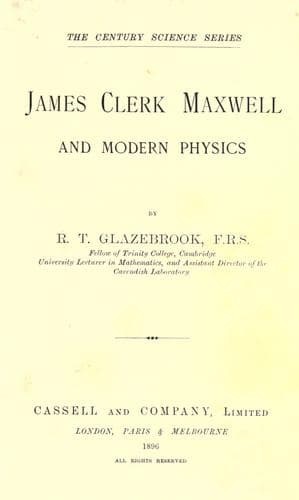
James Clerk Maxwell and Modern PhysicsGlazebrook, Richard
History
James Clerk Maxwell and Modern Physics
Glazebrook, Richard
Maxwell, James Clerk, 1831-1879; Physics -- History
“he still occasioned some concern to the more conventional
amongst his friends by the originality and simplicity of his
ways. His replies in ordinary conversation were indirect and
enigmatical, often uttered with hesitation and in a monotonous
key. While extremely neat in his person, he had a rooted
objection to the vanities of starch and gloves. He had a pious
horror of destroying anything, even a scrap of writing-paper.
He preferred travelling by the third class in railway journeys,
saying he liked a hard seat. When at table he often seemed
abstracted from what was going on, being absorbed in observing
the effects of refracted light in the finger-glasses, or in
trying some experiment with his eyes--seeing round a corner,
making invisible stereoscopes, and the like. Miss Cay used
to call his attention by crying, ‘Jamsie, you’re in a prop.’
He never tasted wine; and he spoke to gentle and simple in
exactly the same tone. On the other hand, his teachers--Forbes
above all--had formed the highest opinion of his intellectual
originality and force; and a few experienced observers, in
watching his devotion to his father, began to have some inkling
of his heroic singleness of heart. To his college companions,
whom he could now select at will, his quaint humour was an
endless delight. His chief associates, after I went to the
University of Glasgow, were my brother, Robert Campbell (still
at the Academy), P. G. Tait, and Allan Stewart. Tait went
to Peterhouse, Cambridge, in 1848, after one session of the
University of Edinburgh; Stewart to the same college in 1849;
Maxwell did not go up until 1850.”
During this period he wrote two important papers. The one, on “Rolling
Curves,” was read to the Royal Society of Edinburgh by Professor
Kelland--(“it was not thought proper for a boy in a round jacket to
mount the rostrum”)--in February, 1849; the other, on “The Equilibrium
of Elastic Solids,” appeared in the spring of 1850.
The vacations were spent at Glenlair, and we learn from letters to
Professor Campbell and others how the time was passed.
“On Saturday,” he writes[11]--April 26th, 1848, just after his
arrival home--“the natural philosophers ran up Arthur’s Seat with the
barometer. The Professor set it down at the top.... He did not set it
straight, and made the hill grow fifty feet; but we got it down again.”
In a letter of July in the same year he describes his laboratory:--
“I have regularly set up shop now above the wash-house at the
gate, in a garret. I have an old door set on two barrels, and
two chairs, of which one is safe, and a skylight above which
will slide up and down.
Public-domain text, read in full here on John Shaqi.
Reviews
Reviews
No reviews yet
Be the first to share your thoughts on this work.
Join the Discussion
Join the discussion
Sign in to leave a comment or review.
Sign InorCreate an account