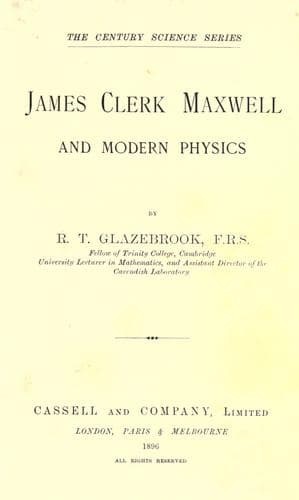
James Clerk Maxwell and Modern PhysicsGlazebrook, Richard
History
James Clerk Maxwell and Modern Physics
Glazebrook, Richard
Maxwell, James Clerk, 1831-1879; Physics -- History
“Fortunately, there is no question here whether the University
should continue to be a place of liberal education, or
should devote itself to preparing young men for particular
professions. Hence, though some of us may, I hope, see reason
to make the pursuit of science the main business of our lives,
it must be one of our most constant aims to maintain a living
connexion between our work and the other liberal studies of
Cambridge, whether literary, philological, historical, or
philosophical.
“There is a narrow professional spirit which may grow up among
men of science just as it does among men who practise any other
special business. But surely a University is the very place
where we should be able to overcome this tendency of men to
become, as it were, granulated into small worlds, which are
all the more worldly for their very smallness? We lose the
advantage of having men of varied pursuits collected into one
body if we do not endeavour to imbibe some of the spirit even
of those whose special branch of learning is different from our
own.”
Another expression of his views on the position of Physics at the time
will be found in his address to Section A of the British Association,
when President at the Liverpool meeting of 1870.
CHAPTER VI.
CAMBRIDGE--THE CAVENDISH LABORATORY.
But the laboratory was not yet built. A Syndicate, of which Maxwell
was a member, was appointed to consider the question of a site, to
take professional advice, and to obtain plans and estimates. Professor
Maxwell and Mr. Trotter visited various laboratories at home and
abroad for the purpose of ascertaining the best arrangements. Mr. W.
M. Fawcett was appointed architect; the tender of Mr. John Loveday,
of Kebworth, for the building at a cost of £8,450, exclusive of gas,
water, and heating, was accepted in March, 1872, and the building[38]
was begun during the summer.
In the meantime Maxwell began to lecture, finding a home where he could.
“Lectures begin 24th,” he writes from Glenlair, October 19th,
1872. “Laboratory rising, I hear, but I have no place to erect
my chair, but move about like the cuckoo, depositing my notions
in the Chemical Lecture-room 1st term; in the Botanical in
Lent, and in Comparative Anatomy in Easter.”
It was not till June, 1874, that the building was complete, and on
the 16th the Chancellor formally presented his gift of the Cavendish
Laboratory to the University. In the correspondence previous to this
time it was spoken of as the Devonshire Laboratory. The name Cavendish
commemorated the work of the great physicist of a century earlier,
whose writings Maxwell was shortly to edit, as well as the generosity
of the Chancellor.
In their letter of thanks to the Duke of Devonshire the University
write:--
Public-domain text, read in full here on John Shaqi.
Reviews
Reviews
No reviews yet
Be the first to share your thoughts on this work.
Join the Discussion
Join the discussion
Sign in to leave a comment or review.
Sign InorCreate an account