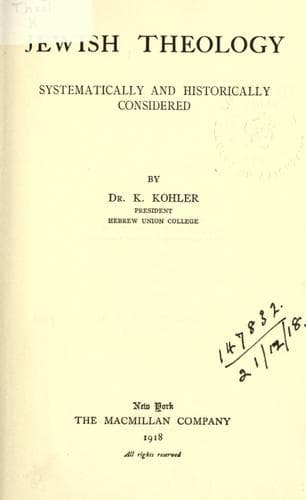
Jewish Theology, Systematically and Historically ConsideredKohler, Kaufmann
Religion
Jewish Theology, Systematically and Historically Considered
Kohler, Kaufmann
Judaism -- Doctrines
3. This answers implicitly the question of the origin of demons. Obviously
the belief in malevolent spirits is incompatible with the existence of an
all-benign and all-wise Creator. Accordingly, two alternative explanations
are offered in the rabbinical and apocalyptic writings. According to one,
the demons are half angelic and half animal beings, sharing intelligence
and flight with the angels, sensuality with beasts and with men. Their
double nature is ascribed to incompleteness, because they were created
last of all beings, and their creation was interrupted by the coming of
the Sabbath, putting an end to all creation.(568) According to the other
view they are the offspring of the “fallen angels,” issuing from the union
of the angels with the daughters of men as described in Gen. VI, 1 f.
These spread the virus of impurity over all the earth, causing carnal
desire and every kind of lewdness. The whole world of demons is regarded
as alienated from God by the rebellion of the heavenly hosts, as if the
fall of man by sin had its prototype in the celestial sphere.(569) A
rabbinical legend, which corresponds with a Persian myth, ascribes the
origin of demons to the intercourse of Adam with Lilith, the night
spirit.(570) On the other hand, the archangel Samael is said to have cast
lascivious glances at the beauty of Eve, and then to have turned into
Satan the Tempter.(571) The Jewish systems of both angelology and
demonology, first worked out in the apocalyptic literature, were further
elaborated by the Cabbalah.
Angelology found a conspicuous place in the liturgy in connection with the
_Kedushah_ Benediction and likewise in the liturgy and the theology of the
Church.(572)
On the other hand the belief in evil spirits and in Satan, the Evil One,
remained rather a matter of popular credulity and never became a positive
doctrine of the Synagogue. True, the liturgy contained morning prayers
which asked God for protection against the Evil One, and formulas invoking
the angels to shield one during the night from evil spirits.(573) But the
arch-fiend was never invested with power over the soul, depriving man of
his perfect freedom and divine sovereignty, as in the Christian Church.
4. In the formation of the idea of the arch-fiend, Satan, we can observe
the interworking of several elements. The name Satan in no way indicates a
demon. It denotes simply the adversary, the one who offers hindrances. The
name was thus applied to the accuser at court.(574) In Zechariah and in
Job(575) Satan appears at the throne of God as the prosecutor, roaming
about the earth to espy the transgressions of men, seeking to lure them to
their destruction. In the Books of Chronicles(576) Satan has become a
proper name, meaning the Seducer.
Public-domain text, read in full here on John Shaqi.
Reviews
Reviews
No reviews yet
Be the first to share your thoughts on this work.
Elsewhere in the archive
Join the Discussion
Join the discussion
Sign in to leave a comment or review.
Sign InorCreate an account