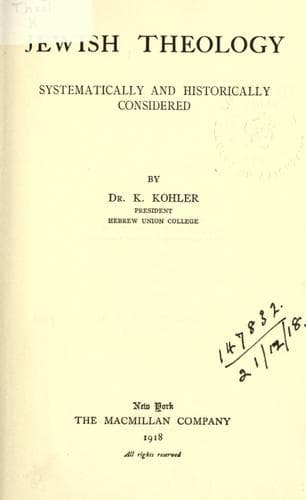
Jewish Theology, Systematically and Historically ConsideredKohler, Kaufmann
Religion
Jewish Theology, Systematically and Historically Considered
Kohler, Kaufmann
Judaism -- Doctrines
7. Another attribute of God which received some attention, owing to the
frequent mention of the omnipotence of God in the Bible, was _ha Geburah_
(the Power). A familiar rabbinic expression is: “We have heard from the
mouth of the Power,” that is, from the divine omnipotence.(617) Two
fundamental principles were early perceived in the moral order of the
world: the punitive justice and compassion of God. These were taken as the
meanings of the two most common Biblical names of God, _JHVH_ and
_Elohim_. Elohim, being occasionally used in dispensing justice,(618) was
thought to signify God in His capacity as Judge of the whole earth, and
hence as the divine Justice. JHVH, on the other hand, meant the divine
mercy, as it was used in the revelation of the long-suffering and merciful
God to Moses after the sin of Israel before the golden calf.(619) Thus
both the rabbis and Philo(620) often speak of these two attributes,
justice and mercy, as though they constituted independent beings,
deliberating with God as to what He should do. The Midrash tells in a
parable how before the creation of man, Justice, Mercy, Truth, and Peace
were called in by God as His counselors to deliberate whether or no man
should be created.(621)
8. One Haggadah concludes from the passage about Creation in Proverbs,
that there are three creative powers, Wisdom, Understanding, and
Knowledge.(622) Another derives from Scripture seven creative principles:
Knowledge, Understanding, Might, Grace and Mercy, Justice and Rebuke;(623)
and seven attributes which do service before God’s throne: Wisdom,
Judgment and Justice, Grace and Mercy, Truth and Peace.(624) By combining
these lists of three and seven this was finally enlarged to ten, which
became the basis for the entire mystic lore. Thus the Babylonian master
Rab enumerates ten creative principles: Wisdom, Understanding, and
Knowledge, Might and Power, Rebuke, Justice and Righteousness, Love and
Mercy.(625) It is hard to say whether the ten attributes of the Haggadah
are at all connected with the ten _Sefiroth_ (cosmic forces or circles) of
the Cabbalah. These last are hardly the creation of pure monotheism, but
rather emanations from the infinite, conceived after the pattern of
heathen ideas.(626)
Public-domain text, read in full here on John Shaqi.
Reviews
Reviews
No reviews yet
Be the first to share your thoughts on this work.
Elsewhere in the archive
Join the Discussion
Join the discussion
Sign in to leave a comment or review.
Sign InorCreate an account