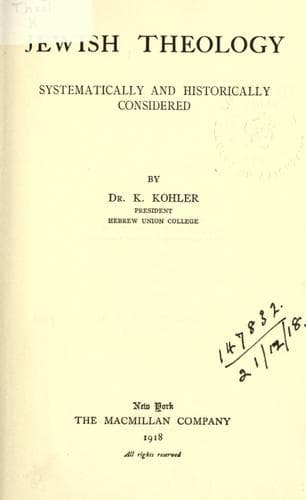
Jewish Theology, Systematically and Historically ConsideredKohler, Kaufmann
Religion
Jewish Theology, Systematically and Historically Considered
Kohler, Kaufmann
Judaism -- Doctrines
9. The assumption of all these intermediaries aimed chiefly to
spiritualize the conception of God and to elevate Him above all
child-like, anthropomorphic views, so that He becomes a free Mind ruling
the whole universe. At the same time, it became natural to ascribe
material substance to these intermediaries. As they filled the chasm
between the supermundane Deity and the world of the senses, they had to
share the nature of both matter and mind. Hence the Shekinah and the Holy
Spirit are described by both the rabbis and the medieval philosophers as a
fine, luminous, or ethereal substance.(627) The entire ancient and
medieval systems were modeled after the idea of a ladder leading up, step
by step, from the lowest to the highest sphere; God, the Most High, being
at the same time above the highest rung of the ladder and yet also a part
of the whole.
10. Our modern system of thought holds the relation of God to nature and
man to be quite different from all this. To our mind God is the only moral
and spiritual power of life. He is mirrored in the moral and spiritual as
well as intellectual nature of man, and therefore is near to the human
conscience, owing to the divine forces within man himself. Not the world
without, but the world within leads us to God and tells us what God is.
Hence we need no intermediary beings, and they all evaporate before our
mental horizon like mist, pictures of the imagination without objective
reality. Ibn Ezra says in the introduction to his commentary on the Bible
that the human reason is the true intermediating angel between God and
man, and we hold this to be true of both the intellect and the conscience.
For the theologian and the student of religion to-day the center of
gravity of religion is to be sought in psychology and anthropology. In all
his upward striving, his craving and yearning for the highest and the
best, in his loftiest aspirations and ideals, man, like Isaiah the
prophet, can behold only the hem of God’s garment; he seeks God above him,
because he feels Him within himself. He must pass, however, through the
various stages of growth, until his self-knowledge leads to the knowledge
of the God before whom he kneels in awe. Then finally he feels Him as his
Father, his Educator in the school of life, the Master of the universal
plan in which the individual also has a place in building up the divine
kingdom of truth, justice, and holiness on earth. For centuries he groped
for God, until he received a Book to serve as “a lamp to his feet and a
light to his path,” to interpret to him his longing and his craving.
Israel’s Book of Books must ever be re-read and re-interpreted by Israel,
the keeper of the book, through ages yet to come. Well may we say: the
mediator between God and the world is _man_, the son of God; the mediator
between God and humanity is _Israel_, the people of God.
PART II. MAN
Chapter XXXIII. Man’s Place in Creation
Public-domain text, read in full here on John Shaqi.
Reviews
Reviews
No reviews yet
Be the first to share your thoughts on this work.
Elsewhere in the archive
Join the Discussion
Join the discussion
Sign in to leave a comment or review.
Sign InorCreate an account