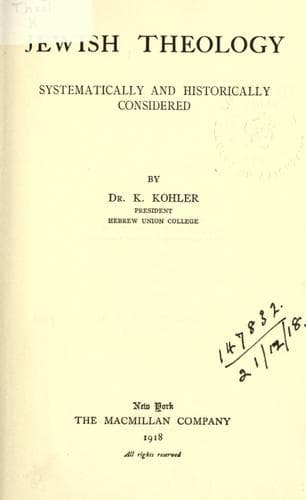
Jewish Theology, Systematically and Historically ConsideredKohler, Kaufmann
Religion
Jewish Theology, Systematically and Historically Considered
Kohler, Kaufmann
Judaism -- Doctrines
1. The doctrine concerning man is inseparably connected with that about
God. Heathenism formed its deities after the image of man; they were
merely human beings of a larger growth. Judaism, on the contrary, asserts
that God is beyond comparison with mankind; He is a purely spiritual being
without form or image, and therefore utterly unlike man. On the other
hand, man has a divine nature, as he was made in the image of God,
fashioned after His likeness. The highest and deepest in man, his mental,
moral, and spiritual life, is the reflection of the divine nature
implanted within him, a force capable of ever greater development toward
perfection. This unique distinction among all creatures gives man the
highest place in all creation.
2. The superiority of the human race is expressed differently in various
passages in Scripture. According to the first chapter of Genesis the whole
work of creation finds its culmination in man, whose making is introduced
by a solemn appeal of God to the hosts of heaven: “Let us make man in our
image, after our likeness.”(628) This declaration proclaimed that man was
the completion and the climax of the physical creation, as well as the
beginning of a new order of creation, a world of moral aims and purposes,
of self-perfection and self-control. In the world of man all life is
placed at the service of a higher ideal, after the divine pattern.
The second chapter of Genesis depicts man’s creation differently. Here he
appears as the first of created beings, leading a life of perfect
innocence in the garden of divine bliss. Before him God brings all the
newly created beings that he may give them a name and a purpose. But the
Serpent enters Paradise as tempter, casting the seed of discord into the
hearts of the man and the woman. As they prove too feeble to resist
temptation, they can no longer remain in the heavenly garden in their
former happy state. Only the memory of Paradise remains, a golden dream to
cast hope over the life of struggle and labor into which they enter. The
idea of the legend is that man’s proper place is not among beings of the
earth, but he can reach his lofty destiny only by arduous struggle with
the world of the senses and a constant striving toward the divine. The
same idea is expressed more directly in the eighth Psalm:
“What is man, that Thou art mindful of him?
And the son of man, that Thou thinkest of him?
Yet Thou hast made him but little lower than the godly beings
(Elohim)
And hast crowned him with glory and honor.
Thou madest him to have dominion over the works of Thy hands;
Thou hast put all things under his feet.”
Public-domain text, read in full here on John Shaqi.
Reviews
Reviews
No reviews yet
Be the first to share your thoughts on this work.
Elsewhere in the archive
Join the Discussion
Join the discussion
Sign in to leave a comment or review.
Sign InorCreate an account