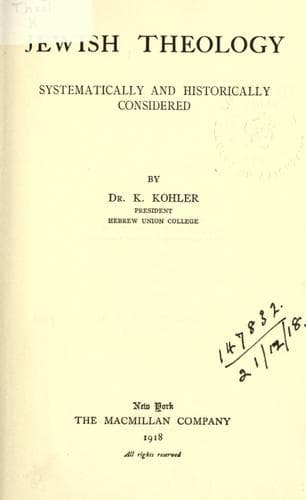
Jewish Theology, Systematically and Historically ConsideredKohler, Kaufmann
Religion
Jewish Theology, Systematically and Historically Considered
Kohler, Kaufmann
Judaism -- Doctrines
2. The problem of human destiny is answered by Judaism with the idea that
God is the ideal and pattern of all morality. The answer given, then, is
“To walk in the ways of God, to be righteous and just,” as He is.(656) The
prophet Micah expressed it in the familiar words: “It has been told thee,
O man, what is good, and what the Lord doth require of thee: Only to do
justly, and to love mercy, and to walk humbly with thy God.”(657)
Accordingly the Bible considers men of the older generations the
prototypes of moral conduct, “righteous men who walked with God.” Such men
were Enoch, Noah, and above all Abraham, to whom God said: “I am God
Almighty; walk before Me, and be thou whole-hearted. And I will make My
covenant between thee and Me.”(658) The rabbis singled out Abraham as the
type of a perfect man on account of his love of righteousness and peace;
contrasting him with Adam who sinned, they beheld him as “the great man
among the heroes of the ancient times.” They even considered him the type
of true humanity, in whom the object of creation was attained.(659)
3. This moral consciousness, however, which tells man to walk in the ways
of God and be perfect, is also the source of shame and remorse. With such
an ideal man must feel constantly that he falls short, that he is not what
he ought to be. Only the little child, who knows nothing as yet of good
and evil, can preserve the joy of life unmarred. Similarly, primitive man,
being ignorant of guilt, could pass his days without care or fear. But as
soon as he becomes conscious of guilt, discord enters his soul, and he
feels as if he had been driven from the presence of God.
This feeling is allegorized in the Paradise legend. The garden of bliss,
half earthly, half heavenly, which is elsewhere called the “mountain of
God,”(660) a place of wondrous trees, beasts, and precious stones, whence
the four great rivers flow, is the abode of divine beings. The first man
and woman could dwell in it only so long as they lived in harmony with God
and His commandments. As soon as the tempter in the shape of the serpent
called forth a discord between the divine will and human desire, man could
no longer enjoy celestial bliss, but must begin the dreary earthly life,
with its burdens and trials.
Public-domain text, read in full here on John Shaqi.
Reviews
Reviews
No reviews yet
Be the first to share your thoughts on this work.
Elsewhere in the archive
Join the Discussion
Join the discussion
Sign in to leave a comment or review.
Sign InorCreate an account