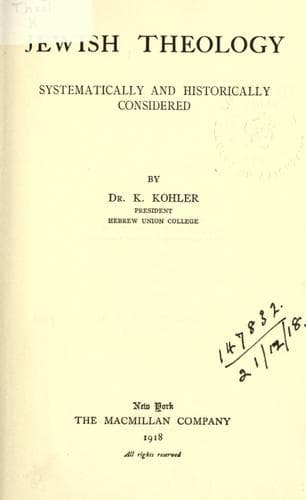
Jewish Theology, Systematically and Historically ConsideredKohler, Kaufmann
Religion
Jewish Theology, Systematically and Historically Considered
Kohler, Kaufmann
Judaism -- Doctrines
4. This story of the fall of the first man is an allegorical description
of the state of childlike innocence which man must leave behind in order
to attain true strength of character. It is based upon a view common to
all antiquity of a descent of the race; that is: first came the golden
age, when man led a life of ease and pleasure in company with the gods;
then an age of silver, another of brass, and finally the iron age, with
its toil and bitter woe. Thus did evil deeds and wild passions increase
among men. This view fails utterly to recognize the value of labor as a
civilizing force making for progress, and it contradicts the modern
historical view. The prophets of Israel placed the golden age at the end,
not the beginning of history, so that the purpose of mankind was to
establish a heavenly kingdom upon the earth. In fact, the fall of man is
not referred to anywhere in Scripture and never became a doctrine, or
belief, of Judaism. On the contrary, the Hellenistic expounders of the
Bible take it for granted that the story is an allegory, and the book of
Proverbs understands the tree of life symbolically, in the verse: “She
(the Torah) is a tree of life to them that lay hold upon her.”(661)
5. Still the rabbis in Talmud and Midrash accepted the legend in good
faith as historical(662) and took it literally as did the great English
poet:
“The fruit
Of that forbidden tree whose mortal taste
Brought death into the world, and all our woe,
With loss of Eden.”
In fact, they even followed the Persian dualism with its evil principle,
the primeval serpent, or the Babylonian legend of the sea-monster Tiamat,
and regarded the serpent in Paradise as a demon. He was identified with
Satan, the arch-fiend, and later with evil in general, the _yezer ha
ra_.(663) Thus the belief arose that the poisonous breath of the serpent
infected all generations, causing death even of the sinless.(664) The
apocrypha also held that the envy of Satan brought death into the
world.(665) This prepared for the dismal church doctrine of original sin,
the basis of Paul’s teachings, which demanded a blood atonement for
curse-laden humanity, and found it after the pagan pattern in the
vicarious sacrifice of a dying god.(666)
Public-domain text, read in full here on John Shaqi.
Reviews
Reviews
No reviews yet
Be the first to share your thoughts on this work.
Elsewhere in the archive
Join the Discussion
Join the discussion
Sign in to leave a comment or review.
Sign InorCreate an account