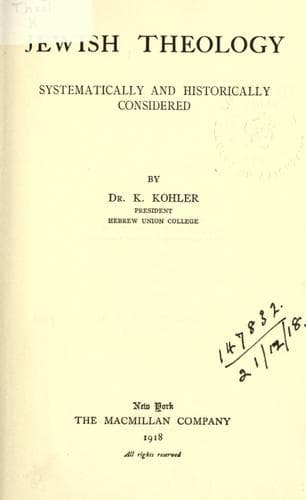
Jewish Theology, Systematically and Historically ConsideredKohler, Kaufmann
Religion
Jewish Theology, Systematically and Historically Considered
Kohler, Kaufmann
Judaism -- Doctrines
Against such perversion of the simple Paradise story the sound common
sense of the Jewish people rebelled. While the early Talmudists
occasionally mention the poisoning of the human race by the serpent, they
find an antidote for the Jewish people in the covenant with Abraham or
that of Sinai.(667) One cannot, however, discern the least indication of
belief in original sin, either as inherent in the human race or inherited
by them. Nor does the liturgy express any such idea, especially for the
Day of Penitence, when it would certainly be mentioned if the conception
found any place in Jewish doctrine. On the contrary, the prevailing
thought of Judaism is that of Deuteronomy and Ezekiel,(668) that “Each man
dies by his own sin,” that every soul must bear only the consequences of
his own deeds. The rabbis even state that no man dies unless he has
brought it upon himself by his own sin, and mention especially certain
exceptions to this rule, such as the four saintly men who died without
sin,(669) or certain children whose death was due to the sin of their
parents.(670) They could never admit that the whole human race was so
corrupted by the sin of the first man that it is still in a state of
sinfulness.
6. Of course, the rabbinical schools took literally the Biblical story of
the fall of man and laid the chief blame upon woman, who fell a prey to
the wiles of the serpent. This is done even by Ben Sira, who says: “With
woman came the beginning of sin, and through her we all must die.”(671) So
the Talmud says that due to woman, man, the crown, light, and life of
creation, lost his purity, his luster, and his immortality.(672) The
Biblical verse, “They did eat, and the eyes of them both were opened,” is
interpreted by Rabbi Johanan ben Zakkai and Rabbi Akiba as “They saw the
dire consequences of their sin upon all coming generations.”(673) The fall
of man is treated most elaborately in the same spirit in the two
apocalyptic books written after the destruction of the Second Temple, the
Apocalypse of Baruch and the IV Book of Esdras.(674) The incompatibility
of divine love with the sufferings of man and of the Jewish people on
account of the sin of the first man is solved by an appeal to the final
Day of Judgment, and the striking remark is added that, after all, “each
is his own Adam and is held responsible for his own sin.” We cannot deny
that these two books contain much that is near the Paulinian view of
original sin. It seems, however, that the Jewish teachers were put on
their guard by the emphasis of this pessimistic dogma by the nascent
Church, and did their best to give a different aspect to the story of the
first sin. Thus they say: “If Adam had but shown repentance, and done
penance after he committed his sin, he would have been spared the death
penalty.”(675) Moreover, they actually represent Adam and Eve as patterns
of repentant sinners, who underwent severe penance and thus obtained the
Public-domain text, read in full here on John Shaqi.
Reviews
Reviews
No reviews yet
Be the first to share your thoughts on this work.
Elsewhere in the archive
Join the Discussion
Join the discussion
Sign in to leave a comment or review.
Sign InorCreate an account