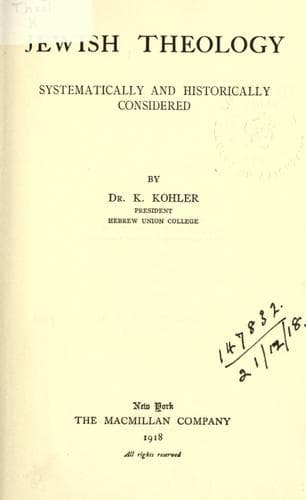
Jewish Theology, Systematically and Historically ConsideredKohler, Kaufmann
Religion
Jewish Theology, Systematically and Historically Considered
Kohler, Kaufmann
Judaism -- Doctrines
8. In fact, the whole Paradise story could never be made the basis for a
dogma. The historicity of the serpent is denied by Saadia;(684) the rabbis
transfer Paradise with the tree of life to heaven as a reward for the
future;(685) and both Nahmanides the mystic and Maimonides the philosopher
give it an allegorical meaning.(686) On the other hand, the Haggadic
teachers perceived the simple truth that a life of indolence in Paradise
would incapacitate man for his cultural task, and that the toils and
struggles inflicted on man as a curse are in reality a blessing. Therefore
they laid special stress on the Biblical statement: “He put man into the
garden of Eden to dress it and to keep it.”(687) The following parable is
especially suggestive: “When Adam heard the stern sentence passed: ‘Thou
shalt eat the herb of the field,’ he burst into tears, and said: ‘Am I and
my ass to eat out of the same manger?’ Then came another sentence from God
to reassure him, ‘In the sweat of thy face shalt thou eat bread,’ and
forthwith he became aware that man shall attain a higher dignity by dint
of labor.”(688) Indeed, labor transforms the wilderness into a garden and
the earth into a habitation worthy of the son of God. The “book of the
generations of man” which begins with Adam is accordingly not the history
of man’s descent, but of his continuous ascent, of ever higher
achievements and aspirations; it is not a record of the fall of man, but
of his rise from age to age. According to the Midrash(689) God opened
before Adam the book with the deeds and names of the leading spirits of
all the coming generations, showing him the latent powers of the human
intellect and soul. The phrase, “the fall of man,” can mean, in fact, only
the inner experience of the individual, who does fall from his original
idea of purity and divine nobility into transgression and sin. It cannot
refer to mankind as a whole, for the human race has never experienced a
fall, nor is it affected by original or hereditary sin.
Chapter XXXVI. God’s Spirit in Man
1. Man is placed in an animal world of dull feelings, of blind and crude
cravings. Yet his clear understanding, his self-conscious will and his
aspirations forward and upward lead him into a higher world where he
obtains insight into the order and unity of all things. By the spirit of
God he is able to understand material things and grasp them in their
relations; thus he can apply all his knowledge and creative imagination to
construct a world of ideals. But this world, in all its truth, beauty and
goodness, is still limited and finite, a feeble shadow of the infinite
world of God. As the Bible says: “The spirit of man is the lamp of the
Lord, searching all the inward parts.”(690) “It is a spirit in man, and
the breath of the Almighty, that giveth them understanding.”(691)
Public-domain text, read in full here on John Shaqi.
Reviews
Reviews
No reviews yet
Be the first to share your thoughts on this work.
Elsewhere in the archive
Join the Discussion
Join the discussion
Sign in to leave a comment or review.
Sign InorCreate an account