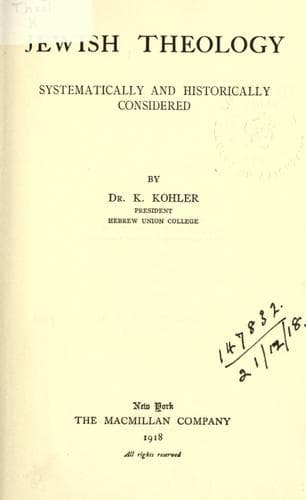
Jewish Theology, Systematically and Historically ConsideredKohler, Kaufmann
Religion
Jewish Theology, Systematically and Historically Considered
Kohler, Kaufmann
Judaism -- Doctrines
3. Thus the diverse gifts of the divine spirit are distributed differently
among the various classes and tribes of men, according to their capacity
and the corresponding task which is assigned them by Providence. The
divine spark is set aglow in each human soul, sometimes feebly, sometimes
brightly, but it blazes high only in the privileged personality or group.
The mutual relationship between God and man is recognized by the Synagogue
in the Eighteen Benedictions, where the one directly following the three
praises of God is devoted to wisdom and knowledge: “Thou favorest man with
knowledge, and teachest mortals understanding. So favor us with knowledge,
understanding, and discernment from Thee. Blessed art Thou, O Lord,
gracious Giver of knowledge.”(695) This petition, remarks Jehuda ha
Levi,(696) deserves its position as first among these prayers, because
wisdom brings us nearer to God. It is also noteworthy that the Synagogue
prescribes a special benediction at the sight of a renowned sage, even if
he is not a Jew, reading, “Praised be He who has imparted of His wisdom to
flesh and blood.”(697)
4. Maimonides holds that in the same degree as a man studies the works of
God in nature, he will be filled with longing for direct knowledge of God
and true love of Him.(698) “Not only religion, but also the sciences
emanate from God, both being the outcome of the wisdom which God imparts
to all nations,”—thus wrote a sixteenth-century rabbi, Loewe ben Bezalel
of Prague, known usually as “the eminent Rabbi Loewe.”(699) The men of the
Talmud also accord the palm in certain types of knowledge to heathen
sages, and did not hesitate to ascribe to some heathens the highest
knowledge of God in their time.(700) As a mystic of the thirteenth
century, Isaac ben Latif, says: “That faith is the most perfect which
perceives truth most fully, since God is the source of all truth.”(701) Of
the two heads of the Babylonian academies, Rab and Samuel, one asserted
that Moses through his prophetic genius reached forty-nine of the fifty
degrees of the divine understanding (as the fiftieth is reserved for God
alone), while the other claimed the same distinction for King Solomon as
the result of his wisdom.(702)
Public-domain text, read in full here on John Shaqi.
Reviews
Reviews
No reviews yet
Be the first to share your thoughts on this work.
Elsewhere in the archive
Join the Discussion
Join the discussion
Sign in to leave a comment or review.
Sign InorCreate an account