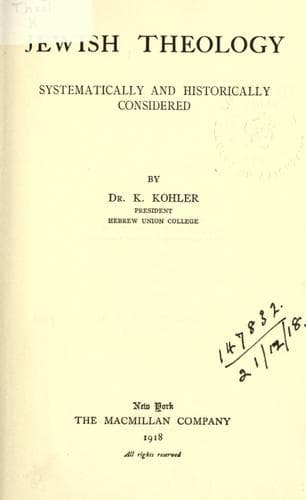
Jewish Theology, Systematically and Historically ConsideredKohler, Kaufmann
Religion
Jewish Theology, Systematically and Historically Considered
Kohler, Kaufmann
Judaism -- Doctrines
5. Thus the spirit of God creates in man both consciously and
unconsciously a world of ideas, which proves him a being of a higher order
in creation. This impulse may work actively, searching, investigating, and
creating, or passively as an instrument of a higher power. At first it is
a dim, uncertain groping of the spirit; then the mind acquires greater
lucidity by which it illumines the dark world; and, as one question calls
for the other and one thought suggests another, the world of ideas opens
up as a well-connected whole. Thus man creates by slow steps his
languages, the arts and sciences, ethics, law and all the religions with
their varying practices and doctrines. At times this spirit bursts forth
with greater vehemence in great men, geniuses who lift the race with one
stroke to a higher level. Such men may say, in the words of David, the
holy singer: “The spirit of the Lord spoke by me, and His word was upon my
tongue.”(703) They may repeat the experience of Eliphaz the friend of Job:
“Now a word was secretly brought to me,
And mine ear received a whisper thereof.
In thoughts from the visions of the night,
When deep sleep falleth on men,
Fear came upon me, and trembling,
And all my bones were made to shake.
Then a spirit passed before my face,
That made the hair of my flesh to stand up.
It stood still, but I could not discern the appearance thereof;
A form was before mine eyes;
I heard a still voice.”(704)
In such manner men of former ages received a religious revelation, a
divine message.
6. The divine spirit always selects as its instruments individuals with
special endowments. Still, insight into history shows that these men must
needs have grown from the very heart of their own people and their own
age, in order that they might hold a lofty position among them and command
attention for their message. However far the people or the age may be from
the man chosen by God, the multitude must feel at least that the divine
spirit speaks through him, or works within him. Or, if not his own time,
then a later generation must respond to his message, lest it be lost
entirely to the world.
The rabbis, who knew nothing of laws of development for the human mind,
assumed that the first man, made by God Himself, must have known every
branch of knowledge and skill, that the spirit of God must have been most
vigorous in him.(705) They therefore believed in a primeval revelation,
coeval with the first man. Our age, with its tremendous emphasis on the
historical view, sees the divine spirit manifested most clearly in the
very development and growth of all life, social, intellectual, moral and
spiritual, proceeding steadily toward the highest of all goals. With this
emphasis, however, on process, we must lay stress equally on the origin,
on the divine impulse or initiative in this historical development, the
spirit which gives direction and value to the whole.
Public-domain text, read in full here on John Shaqi.
Reviews
Reviews
No reviews yet
Be the first to share your thoughts on this work.
Elsewhere in the archive
Join the Discussion
Join the discussion
Sign in to leave a comment or review.
Sign InorCreate an account