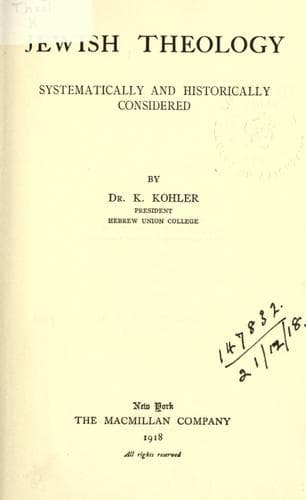
Jewish Theology, Systematically and Historically ConsideredKohler, Kaufmann
Religion
Jewish Theology, Systematically and Historically Considered
Kohler, Kaufmann
Judaism -- Doctrines
5. In the earlier period, then, the rule of JHVH seems to have been
confined to Israel as the people of His covenant. During the Second Temple
Jerusalem was called the “city of the great King”(1065) and the
constitution was considered by Josephus to have been a theocracy, that is,
a government by God.(1066) Indeed, the entire Mosaic code has as its main
purpose to make Israel a “kingdom of priests,” over which JHVH, the God of
the covenant, was alone to rule as King. The chief object of the strict
nationalists, in opposition to the cosmopolitanism of the Hellenists, was
that this government of God, in its intimate association with the Holy
Land and the Holy People, should be maintained unchanged for all the
future. Thus the book of Daniel predicts the speedy downfall of the fourth
world-kingdom and the establishment of the kingdom of God through Israel,
“the people of the saints of the Most High; their kingdom is an
everlasting kingdom.”(1067) Naturally, such a purely nationalistic
conception of the rulership of God does not admit the thought of a mission
or its corollary, the conversion of the heathen.(1068) These appear among
the liberal school of Hillel in their opposition to the more rigorous
Shammaites and the party of the Zealots.(1069) It is, therefore, quite
consistent that the modern nationalists should again dispute the mission
of Israel.
6. As soon as Jewish monotheism had once been conceived by the Jewish mind
as the universal truth, the idea of the mission of Israel as a bearer of
light and a witness of God for the nations, as enunciated by
Deutero-Isaiah, became ever more firmly established. Many Psalms exhort
the people to make known the wondrous doings of God among the nations, so
that the heathen world might at last acknowledge the One and Only
God.(1070) Nay, Israel is even called God’s anointed and prophet,(1071)
and in one Psalm we find Zion, the city of God, elevated to be the
religious metropolis of the world.(1072) The book of Jonah is simply a
refutation of the narrow nationalistic conception of Judaism; it holds
forth the hope of the conversion of the heathen to the true knowledge of
God. In the same spirit Ruth the Moabitess became the type of the heathen
who are eager to “take refuge under the wings of God’s majesty.”(1073) The
author of the book of Job no longer knows of a national God; to him God is
the highest ideal of morality as it lives and grows in the human heart.
The wisdom literature also teaches a God of humanity. Under His wings Shem
and Japheth, the teaching of the Jew and the wisdom of the Greek, can join
hands; the religious truth of the one and the philosophic truth of the
other may harmoniously blend.
Public-domain text, read in full here on John Shaqi.
Reviews
Reviews
No reviews yet
Be the first to share your thoughts on this work.
Elsewhere in the archive
Join the Discussion
Join the discussion
Sign in to leave a comment or review.
Sign InorCreate an account