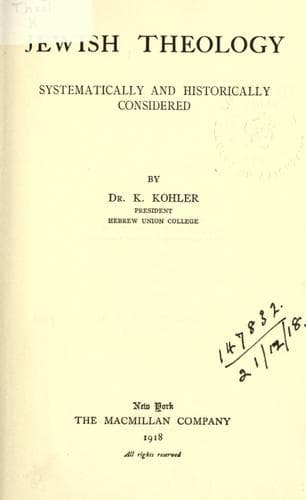
Jewish Theology, Systematically and Historically ConsideredKohler, Kaufmann
Religion
Jewish Theology, Systematically and Historically Considered
Kohler, Kaufmann
Judaism -- Doctrines
7. Thus a new impulse was given to Jewish proselytism in Alexandria, and
the earlier history of Israel, especially the pre-Israelite epoch with its
simple human types, was read in a new light. Enoch(1074) and Noah(1075)
became preachers of penitence, heralds of the pure monotheism from which
the heathen world had departed. Abraham especially, the progenitor of
Israel, was looked upon as a prototype of the wandering missionary people,
converting the heathen.(1076) Wherever he journeyed, his teaching and his
example of true benevolence won souls for the Lord proclaimed by him as
the “God of the heaven and the earth.”(1077) In this sense of missionary
activity were now interpreted the words, “Be thou a blessing ... and in
thy seed shall all the nations of the earth be blessed.”(1078) This was no
longer understood in the original sense, that Abraham by his prosperity
should be an example of a blessed man, to be pointed out in blessing
others; the words were given the higher meaning that Abraham with his
descendants should become a source of blessing for mankind through his
teachings and his conduct, so that all the families of men should attain
blessing and salvation by following his doctrine and example. Thus the
idea of the Jewish mission was connected with Abraham, the “father of a
multitude of nations,”(1079) and this was later on adopted by Paul and
Mohammed in establishing the Church and the Mosque.
8. In contradistinction, then, to the political concept of the kingdom of
God, which Ezekiel still hoped to see established by the exercise of
external power,(1080) the idea assumed now a purely spiritual meaning.
This kingdom of God is accepted by the pious Jew every morning through his
confession of the divine Unity in the Shema. Abraham had anticipated this,
say the rabbis, when he swore by the God of heaven and earth, and so also
had Israel in accepting the Torah at Sinai and at the Red Sea.(1081) In
fact, the kingdom of God began, we are told, with the first man, since,
when he adored God freely as King of the world, every living creature
acknowledged Him also. But only when Israel as a people proclaimed God’s
dominion at the Red Sea, was the throne of God and His kingdom on earth
established for eternity.(1082) And when Ezekiel says: “With a mighty hand
will I be King over you,” they explain this to mean that the people chosen
as the servant of God will be continually constrained anew by the prophets
to recognize His kingdom.(1083) Yea, the closing words of the Song at the
Red Sea, “The Lord shall reign for ever and ever” were taken to imply that
all the nations would in the end recognize only Israel’s One God as King
of the world.(1084) As a matter of fact, the rabbinical view is that every
proselyte, in “taking upon himself the yoke of the sovereignty of God,”
enters that divine Kingdom which at the end of time will embrace all men
and nations.(1085) In the book of Tobit and the Sibylline Oracles also we
Public-domain text, read in full here on John Shaqi.
Reviews
Reviews
No reviews yet
Be the first to share your thoughts on this work.
Elsewhere in the archive
Join the Discussion
Join the discussion
Sign in to leave a comment or review.
Sign InorCreate an account