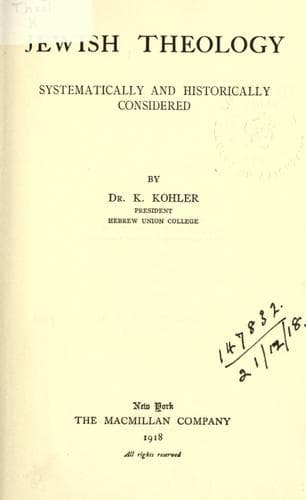
Jewish Theology, Systematically and Historically ConsideredKohler, Kaufmann
Religion
Jewish Theology, Systematically and Historically Considered
Kohler, Kaufmann
Judaism -- Doctrines
find this universalistic conception of the Messianic age expressed.(1086)
9. Accordingly, proselytism found open and solemn recognition both before
and after the time of the Maccabees, as we see in the Psalms,—especially
those which speak of proselytes in the term, “they that fear the
Lord,”(1087) and also in the ancient synagogal liturgy, where the
“proselytes of righteousness” are especially mentioned.(1088) The school
of Hillel followed precisely this course. Matters changed, however, under
the Roman dominion, which was contrasted to the dominion of God especially
from the time of Herod, when the belief became current that “only when the
one is destroyed, will the other arise.”(1089) Particularly after the
Christian Church had become identified with Rome, all missionary endeavors
by the Jews were considered dangerous and were therefore discouraged as
much as possible. In their place arose the hope for a miraculous
intervention of God. In Hellenistic circles the Messiah was believed to be
the future founder of the kingdom of God,(1090) which assumed more and
more of an other-worldly nature, such as the Church developed for it later
on.
10. The more the harsh oppression of the times forced the Jew to isolate
himself and to spend his life in studying and practicing the law,—which
was tantamount to “placing himself under the kingdom of God,”(1091) the
more he lost sight of his sublime mission for the world at large. Only
individual thinkers, such as Jehuda ha Levi and Maimonides, kept a vision
of the world-mission of Israel, when they called Jesus and Mohammed, as
founders of Christianity and Islam, messengers of God to the idolatrous
nations, divinely appointed to bring them nearer to Israel’s truth,(1092)
or when they pointed forward to the time when all peoples will recognize
in the truth their common mother and in God the Father of all
mankind.(1093) A most instructive Midrash on Zechariah IX, 9 gives the
keynote of this belief. “At that time God as the King of Zion will speak
to the righteous of all times, and say to them, ‘Dear as the words of My
teaching are to Me, yet have ye erred in that ye have followed only My
Torah, and have not waited for My world-kingdom. I swear to you that I
shall remember for good him who has waited for My kingdom, as it is said,
Wait ye for Me until the day that I rise up as a witness.’ ”(1094)
Public-domain text, read in full here on John Shaqi.
Reviews
Reviews
No reviews yet
Be the first to share your thoughts on this work.
Elsewhere in the archive
Join the Discussion
Join the discussion
Sign in to leave a comment or review.
Sign InorCreate an account