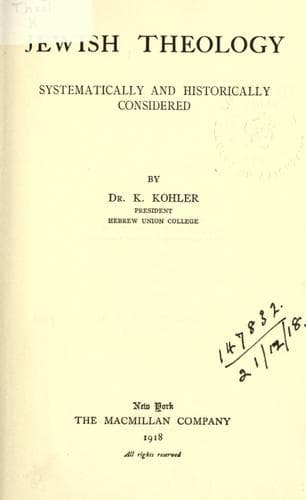
Jewish Theology, Systematically and Historically ConsideredKohler, Kaufmann
Religion
Jewish Theology, Systematically and Historically Considered
Kohler, Kaufmann
Judaism -- Doctrines
1. The checkered, stormy, and yet triumphant march of the Jewish people
through the ages remains the great enigma of history for all those who do
not believe in a divine plan of salvation to be consummated through
Israel. The idea of Israel’s mission alone throws light on its law and its
destiny. Even before God had revealed to the people at Mt. Sinai the Ten
Commandments, the foundation of all religion and morality, and there
concluded with them a covenant for all time, He spoke: “Ye shall be unto
Me a kingdom of priests and a holy nation,” thus consecrating them to be a
priest-people among the nations, and enjoining them to a life of especial
holiness. Possessing as a heritage from the Patriarchs the germ of a
higher religious consciousness, in distinction from all other peoples,
they were to make the cultivation, development, and promotion of the
highest religious truth their life-task, and thus to become the people of
God. At first they were to establish in the Holy Land a theocratic
government, a State in which God alone was the Ruler, while they lived in
priestly isolation from all the nations around. Thus they prepared
themselves for the time when, scattered over all the earth, they might
again work as the priest-people through the ages for the upbuilding of the
universal kingdom of God. This was Israel’s destiny from the very first,
as expressed by the great seer of the Exile when he beheld Israel
wandering forth among the nations, “Ye shall be named the priests of the
Lord; men shall call you the ministers of our God.”(1100)
Public-domain text, read in full here on John Shaqi.
Reviews
Reviews
No reviews yet
Be the first to share your thoughts on this work.
Elsewhere in the archive
Join the Discussion
Join the discussion
Sign in to leave a comment or review.
Sign InorCreate an account