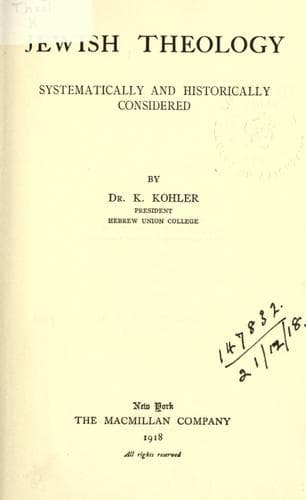
Jewish Theology, Systematically and Historically ConsideredKohler, Kaufmann
Religion
Jewish Theology, Systematically and Historically Considered
Kohler, Kaufmann
Judaism -- Doctrines
2. Among all religions the priest is considered especially holy as the
mediator between God and man, and in his appearance as well as in his mode
of life he must observe special forms of purity and holiness. He alone may
approach the Godhead, ascertain its will, and administer the sacrificial
cult in the sanctuary. He must represent the Divinity in its relation to
the people, embody it in his outward life, enjoy nothing which it abhors,
and touch nothing which could render him impure. These priestly rules
exist among all the nations of antiquity in striking similarity, and
indicate a common origin in the prehistoric period, during which the
entire cult developed through a priestly caste, beginning with simple,
primitive conceptions and transmitted in ever more elaborate form from
father to son. It goes without saying that the priests of the original
Hebrew race, which migrated from Babylonia, retained the ancient customs
and rules. They must also have adopted many other things from neighboring
peoples. During the entire period of the first temple, the priests—despite
all prophetic warnings—preferred the heathen cult with its vainglorious
pomp to the simple worship of the patriarchal times. As everywhere else,
the priesthood of Israel, and later of Judæa as well, thought only of its
own interests, of the retention of its ancient prerogatives, unmindful of
the higher calling to which it had been chosen, to serve the God of truth
and justice, to exemplify true holiness, to stand for moral rather than
ceremonial purity. Yet the sacerdotal institutions were indispensable so
long as the people required a sanctuary where the Deity should dwell, and
where the sacrificial cult should be administered. Every trespass by a
layman on the sanctuary reserved for the priests was considered sacrilege
and called for divine punishment. It was thus necessary to deepen the
popular notion of holiness and of the reverence due the sanctuary, before
these could be elevated into the realm of spirituality and morality. The
priesthood had to be won for the service of the loftier religious ideas,
so that it might gradually educate the people in general for its sublime
priestly mission. This conception underlies both the Mosaic law and its
rabbinical interpretation.
3. Through Biblical and post-Biblical literature and history there runs a
twofold tendency, one anti-sacerdotal,—emanating from the prophets and
later the Hasideans or Pharisees,—the other a mediating tendency,
favorable to the priesthood. The ritualistic piety of the priests was
bitterly assailed by the prophets as being subversive of all morality, and
later on the Sadducean hierarchy also constituted a threat to the moral
and spiritual welfare of the people. Before even the revelation at Sinai
was to take place, we read that warning was given to the priests “not to
break through” and stand above the people.(1101)
Public-domain text, read in full here on John Shaqi.
Reviews
Reviews
No reviews yet
Be the first to share your thoughts on this work.
Elsewhere in the archive
Join the Discussion
Join the discussion
Sign in to leave a comment or review.
Sign InorCreate an account