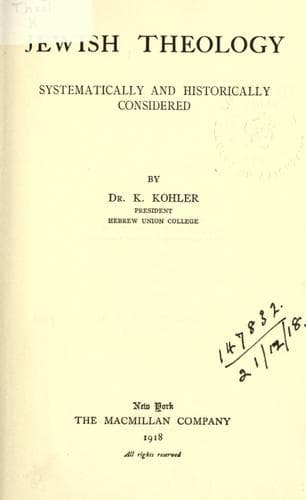
Jewish Theology, Systematically and Historically ConsideredKohler, Kaufmann
Religion
Jewish Theology, Systematically and Historically Considered
Kohler, Kaufmann
Judaism -- Doctrines
On the other hand, the law demands of the Aaronites a peculiar degree of
holiness, since “they offer the bread of their God upon the altar.”(1102)
Their blood must be kept pure by the avoidance of improper marriages.
Everything unclean or polluting must be kept far from them.(1103) The law,
following a tradition which probably arose in ancient Babylon, prescribed
minutely their mode of admission into the divine service, their vestments
and their conditions of life, the ritual of sacrifice and of purity; and
every violation of these laws, every trespass by a layman, was declared to
be punishable with death.(1104) The sanctuary contains no room for the
_nation_ of _priests_; no layman durst venture to cross its threshold.
Even in the legal system of the rabbis the ancient rights and privileges
of the priesthood, dating from the time when they possessed no property,
remained inviolate, and their precedence in everything was
undisputed.(1105)
The glaring contrast between the idea of a universal priesthood of the
people and the institution of the Aaronites is explained by a deeper
insight into history. The success of the reformation under Josiah on the
basis of the Deuteronomic code rested in the last analysis on the fact
that the priests of the house of Zadok at Jerusalem were placed in the
service of the higher prophetic teaching by being rendered the guardians,
executors, and later, in conjunction with the Levites, the teachers of the
Law, as it was presented in the book of the law of Moses, soon afterward
completed. The priesthood, deprived of everything that might remind one of
the former idolatry and heathenish practices, was, in its purer and holier
character, to lead the priest-people to true moral holiness through its
connection with the sanctuary and its ancient cult. Still the impulse for
the moral rebirth of the nation, for the establishment of a priest-people,
did not emanate from the Temple priesthood, nor even from the sacred soil
of Palestine; but from the Synagogue, which began in the Exile, under the
influence of the prophetic word and the Levitical song, in the form of
public worship by the congregation of the pious. Here arose a generation
of godly men, a class of singularly devout ones, living in priestly
holiness, who consecrated their lives to the practice of the law, and whom
the exile seer had designated as the true Israel, the servant of the Lord,
and these formed the nucleus of the renewed Israel.
Public-domain text, read in full here on John Shaqi.
Reviews
Reviews
No reviews yet
Be the first to share your thoughts on this work.
Elsewhere in the archive
Join the Discussion
Join the discussion
Sign in to leave a comment or review.
Sign InorCreate an account