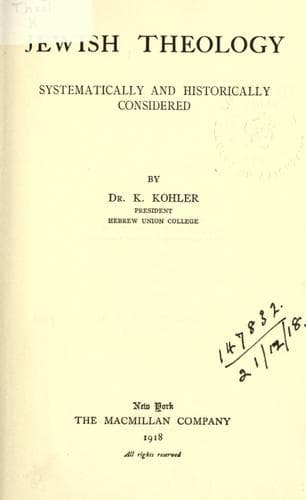
Jewish Theology, Systematically and Historically ConsideredKohler, Kaufmann
Religion
Jewish Theology, Systematically and Historically Considered
Kohler, Kaufmann
Judaism -- Doctrines
4. That which the prophet Ezekiel had attempted in his proposed
constitution(1106) was accomplished in a far more thorough manner by the
Holiness Code, which emanated from his school and became the central
portion of the Mosaic books, and by the so-called Priestly Code, which
followed later. The object was to bring about the sanctification of the
entire people upon the holy soil of the national land, through
institutions embodying the ideal of the holiness of God in the life and
cult of the people. Circumcision, idealized by the prophetic author of
Deuteronomy,(1107) was to be made the sign of the covenant to mark as holy
the progeny of Abraham;(1108) strict laws of marriage were to put an end
to all heathenish unchastity; the Sabbath rest was to consecrate the
labors of the week, the Sabbatical month and year the produce of the
soil.(1109) The prohibition of unclean foods, heretofore reserved, as
among other nations, for the priests and other consecrated persons, was
now applied to the whole community in order that Israel should learn “to
set itself apart from all other nations as a holy people.”(1110) Even
their apparel was to proclaim the priestly holiness of the people by a
blue fringe at the border of the garments.(1111)
Whereas from the time of Ezra to Simon the Just priestly rulers endeavored
to promote the work of educating the people for holiness, the pious men
from among the people made still greater efforts to assert the claim of
holiness for the entire Jewish people as a priest-nation.(1112) The
repasts of these pious fellowships should be in no way inferior in
sanctity to those of the priests in the Temple. New ceremonies of
sanctification were to open and close the Sabbaths and festivals. Symbols
of priestly consecration should adorn forehead and arm in the form of the
phylacteries (_tefillin_), and should be placed at the entrance of every
house in the so-called _mezuzzah_. “God has given unto all an heritage
(the Torah), the kingdom, the priesthood, and the sanctuary”(1113)—this
became the _leitmotif_ for the Pharisaic school, who constantly enlarged
the domain of piety so that it should include the whole of life. Whoever
did not belong to this circle of the pious was regarded with scorn as one
of the lower class (_am ha-aretz_).
Public-domain text, read in full here on John Shaqi.
Reviews
Reviews
No reviews yet
Be the first to share your thoughts on this work.
Elsewhere in the archive
Join the Discussion
Join the discussion
Sign in to leave a comment or review.
Sign InorCreate an account