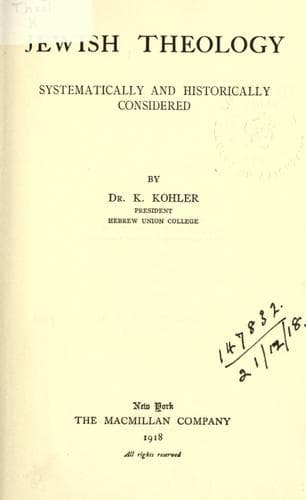
Jewish Theology, Systematically and Historically ConsideredKohler, Kaufmann
Religion
Jewish Theology, Systematically and Historically Considered
Kohler, Kaufmann
Judaism -- Doctrines
6. The leading minds of Judaism felt only pity for the blind obstinacy of
the great mass of heathen, who worshiped the creatures instead of the
Creator, or the stars of heaven instead of Him who is enthroned above the
skies. They regarded heathenism either as evidence of spiritual want and
weakness, or as the result of destiny. Indeed, the words of the
Deuteronomist sound like an echo of Babylonian fatalism when he asserts
that God himself assigned to the nations the worship of the stars as their
inheritance.(1272) Later the opinion gained ground that the heathen
deities were real demons, holding dominion over the nations and leading
them astray.(1273) The exilic seer attacked idolatry most vigorously as
folly and falsehood, and thus the note of derision and irony is struck by
Deutero-Isaiah, the Psalms, and in many of the propaganda writings of the
Hellenistic age, in their references to heathenism.
On the other hand, it is very significant that the Palestinian sages and
their successors condemned heathenism as a moral plague, conducing to
depravity, lewdness, and bloodshed. They regarded the powers of the world,
especially Edom (Rome), as being under the dominion of the Evil One, and
therefore doomed to perish in the flames of Gehenna. As they rejected the
Ten Commandments out of love for bloodshed, lust, and robbery, so,
according to the Haggadists, they will be unable to withstand the last
judgment and will suffer eternal punishment. Since their one desire was to
enjoy the life of this world, their lot in the future will be Gehenna;
while the gates of the Garden of Eden will be open for Israel, the people
oppressed and sorely tried, yet ever faithful to the covenant of
Abraham.(1274) Of course, this view implied both comfort and vengeance,
but we must not forget that the harsh statements contained in the Talmud
owe their origin to bitter distress and cannot be considered Jewish
doctrines, as unfriendly critics frequently do.(1275)
Public-domain text, read in full here on John Shaqi.
Reviews
Reviews
No reviews yet
Be the first to share your thoughts on this work.
Elsewhere in the archive
Join the Discussion
Join the discussion
Sign in to leave a comment or review.
Sign InorCreate an account