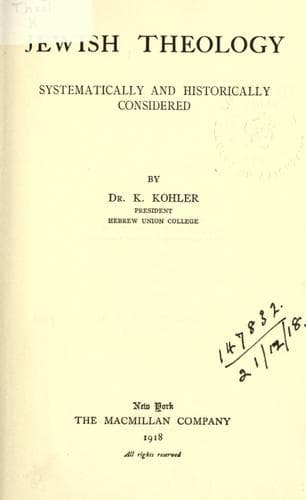
Jewish Theology, Systematically and Historically ConsideredKohler, Kaufmann
Religion
Jewish Theology, Systematically and Historically Considered
Kohler, Kaufmann
Judaism -- Doctrines
7. As has been shown above, the dominant view of the Synagogue is that
eternal salvation belongs to the righteous among the nations as well as
those of Israel. In this sense, Psalm IX, 18, is understood to the effect
that “all those heathens who have forgotten God will go down to the nether
world.”(1276) One of the sages expresses a still broader view: “When
judging the nations, God determines their standard by their best
representatives.”(1277) Many rabbis held the belief that circumcision
secured for the Jew a place in “Abraham’s bosom” while the uncircumcised
are consigned to Gehenna, thus assigning to circumcision a corresponding
place to that of baptism in the Christian Church. This belief seems to be
based upon a passage in Ezekiel, where the prophet speaks of the _arelim_,
or “uncircumcised,” as dwelling in the nether world.(1278) But a number of
passages in the Talmud, especially in the Tosefta,(1279) show that
circumcision was not believed to have the power to save a sinner from
Gehenna, On the other hand, we have the great teaching of R. Johanan ben
Zakkai in opposing his disciple Eliezer ben Hyrcanus, telling that the
sacrifices which atoned for the sins of Israel are paralleled by deeds of
benevolence, which can atone for the sins of the heathen.(1280) Both the
Talmud and Philo state that the seventy bullocks which were offered up
during the seven days of the Feast of Tabernacles were brought by Israel
as sacrifices for the seventy nations of the world.(1281)
8. Where no cause existed to fear the influence of idolatry, friendly
relations with non-Jews were always recommended and cultivated. A non-Jew
who devotes his life to the study and practice of the law, said Rabbi
Meir, is equal to the high priest; for Scripture says: “The laws which, if
a man do, he shall live by them,” implying that pure humanity is the one
essential required by God.(1282) Indeed, Rabbi Meir enjoyed a close
friendship with Œnomaos of Gadara,(1283) a heathen philosopher spoken of
admiringly in Talmudic sources and placed on a par with Balaam as noble
representatives of heathendom. Obviously this good opinion was held,
because both spoke favorably of Judaism, whose “synagogues and
schoolhouses formed the strongest bulwark against the attacks of
Jew-haters.” Other friendships which were described in popular legends and
held up as examples for emulation are those between Jehuda ha Nasi and the
Emperor Antoninus (Severus)(1284) and that of Samuel of Babylonia with
Ablat, a Persian sage.(1285)
Public-domain text, read in full here on John Shaqi.
Reviews
Reviews
No reviews yet
Be the first to share your thoughts on this work.
Elsewhere in the archive
Join the Discussion
Join the discussion
Sign in to leave a comment or review.
Sign InorCreate an account