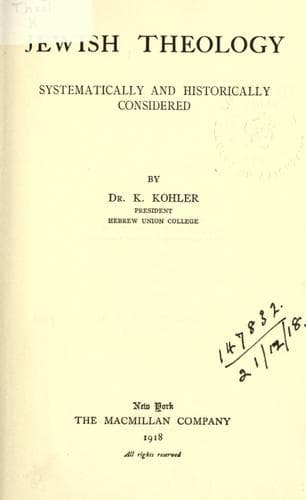
Jewish Theology, Systematically and Historically ConsideredKohler, Kaufmann
Religion
Jewish Theology, Systematically and Historically Considered
Kohler, Kaufmann
Judaism -- Doctrines
9. The Mosaic and Talmudic law prescribed quite different treatment for
those heathen who persisted in idolatrous practices and refused to observe
the laws of humanity, called the seven Noahitic laws, as will be explained
more fully in the next chapter. No toleration could be granted them within
the ancient jurisdiction; “Thou shall show them no mercy” was the phrase
of the law for the seven tribes of Canaan, and this was applied to all
idolaters.(1286) Hence Maimonides lays down the rule in his Code that
“wherever and whenever the Mosaic law is in force, the people must be
compelled to abjure heathenism and accept the seven laws of Noah in the
name of God, or else they are doomed to die.”(1287)
On the other hand, in the very same Code, Maimonides writes in the spirit
of Rabbi Meir: “Not only the Jewish tribe is sanctified by the highest
degree of human holiness, but every human being, without difference of
birth, in whom is the spirit of love and the power of knowledge to devote
his life exclusively to the service of God and the dissemination of His
knowledge, and who, walking uprightly before Him, has cast off the yoke of
the many earthly desires pursued by the rest of men. God is his portion
and his eternal inheritance, and God will provide for his needs, as He did
for the priest and the Levite of yore.”(1288)
10. To be sure, a statement of this nature presents a different judgment
of heathenism from that of the ancient national law. But the historical
and comparative study of religions has caused us to entertain altogether
different views of the various heathen religions, both those representing
primitive stages of childlike imagination and superstition, and those more
developed faiths which inculcate genuine ideals of a more or less lofty
character. Certainly the laws of Deuteronomy, written when the nation had
dwindled down to the little kingdom of Judæa, and those further expounded
in the Mishnah enjoining the most rigorous intolerance toward every
vestige of paganism, had only a theoretical value for the powerless Jewish
nation; while both the Church and the rulers of Islam were largely guided
by them in practical measures. The higher view of Judaism was expressed by
the last of the prophets: “ ‘For from the rising of the sun even unto the
going down of the same My name is great among the nations; and in every
place offerings are presented unto My name, even pure oblations, for My
name is great among the nations,’ saith the Lord of hosts.”(1289) The fact
is that heathenism seeks the God whom Israel by its revelation has found.
In this spirit both Philo and Josephus took the Scriptural passage, “Thou
shalt not curse God,” taking the Hebrew _Elohim_ in the plural sense, “the
gods”; thus they said a Jew must not offend the religious sense of the
heathen by scorn or ridicule, however careful he must be to avoid the
imitation of their practices and superstitions.(1290)
Public-domain text, read in full here on John Shaqi.
Reviews
Reviews
No reviews yet
Be the first to share your thoughts on this work.
Elsewhere in the archive
Join the Discussion
Join the discussion
Sign in to leave a comment or review.
Sign InorCreate an account