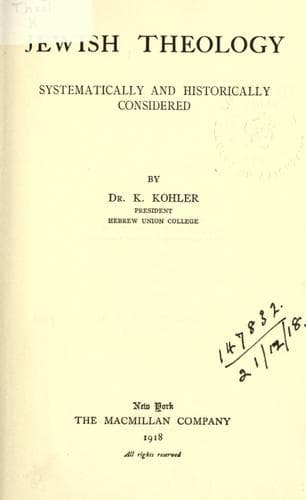
Jewish Theology, Systematically and Historically ConsideredKohler, Kaufmann
Religion
Jewish Theology, Systematically and Historically Considered
Kohler, Kaufmann
Judaism -- Doctrines
3. Meanwhile the relapse of Christianity from monotheism became more
steady and more apparent. The One God of the Jew was pushed into the
background by the “Son of Man”; and the Virgin-Mother with her divine
child became adored like the Queen of Heaven of pagan times, showing
similarity especially to Isis, the Egyptian mother-goddess, with Horus,
the young son-god, on her lap. The pagan deities of the various lands were
transformed into saints of the Church and worshiped by means of images, in
order to win the pagan masses for the Christian faith. The original pure
and absolute monotheism and the stern conception of holiness were thus
turned into their very opposites by the hierarchy and monasticism of the
Church. How, then, could the Jewish people recognize the crucified Christ
as one of their own? One whose preaching seemed to bring them only
damnation and death instead of salvation and life, even while speaking in
the name of Israel’s God after the manner of the prophets of yore? How
could they see in the strange doctrines of the Church any resemblance to
their own system of faith, especially as the very doctrines which repelled
them were those most emphasized by Christianity? Maimonides considered the
adherents of the Roman Church to be idolaters,(1387) a view which was
modified by the Jewish authorities in the West, as they became better
acquainted with Christian doctrines.(1388)
4. The world-empire of the Church was subsequently divided between Rome,
which the Jewish writers called _Edom_,(1389) and Byzantium, which they
named _Yavan_, but neither showed any real advance in religious views and
ideals. On the contrary, they both persecuted with fire and sword the
little people who were faithful to their ancient monotheism, and
suppressed what remained of learning and science. As the Church had the
great task of disciplining wild and semi-barbarous races, there was little
room left for learning or for high ideals. At this time a rigorous avenger
of the persecuted spirit of pure monotheism arose among the sons of
Ishmael in the desert of Arabia in the person of Mohammed, a camel-driver
of Mecca, a man of mighty passions and void of learning, but imbued with
the fire of the ancient prophets of Israel. He felt summoned by Allah, the
God of Abraham, to wage war against the idolatry of his nation and restore
the pure faith of antiquity. He kindled a flame in the hearts of his
countrymen which did not cease, until they had proclaimed the unity of God
throughout the Orient, had put to flight the trinitarian dogma of the
Church in both Asia and Africa, and extended their domain as far as the
Spanish peninsula. He offered the Jews inducements to recognize him as the
last, “the seal,” of the prophets, by promising to adopt some of their
religious practices; but when they refused, he showed himself fanatical
and revengeful, a genuine son of the Bedouins, unrelenting in his wrath
and ending his career as a cruel, sensuous despot of the true Oriental
Public-domain text, read in full here on John Shaqi.
Reviews
Reviews
No reviews yet
Be the first to share your thoughts on this work.
Elsewhere in the archive
Join the Discussion
Join the discussion
Sign in to leave a comment or review.
Sign InorCreate an account