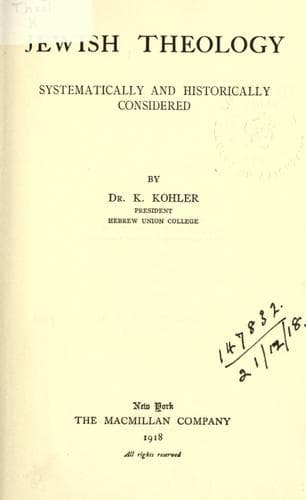
Jewish Theology, Systematically and Historically ConsideredKohler, Kaufmann
Religion
Jewish Theology, Systematically and Historically Considered
Kohler, Kaufmann
Judaism -- Doctrines
type. Nevertheless, he created a religion which led to a remarkable
advancement of intellectual and spiritual culture, and in which Judaism
found a valuable incentive to similar endeavors. Thus Ishmael proved a
better heir to Abraham than was Esau, the hostile brother of Jacob.(1390)
5. The important, yet delicate question, which of the three religions is
the best, the Mohammedan, Christian or Jewish, was answered most cleverly
by Lessing in his _Nathan the Wise_, by adapting the parable of the three
rings, taken from Boccaccio. His conclusion is that the best religion is
the one which induces men best to promote the welfare of their fellow
men.(1391) But the question itself is much older; it was discussed at the
court of the Kaliphs in Bagdad as early as the tenth century, where the
adherents of every religion there represented expressed their opinions in
all candor. For centuries it was the subject of philosophical and
comparative investigations.(1392) Among these, the most thorough and
profound is the _Cuzari_ by the Jewish philosopher and poet, Jehuda ha
Levi. But the parable of the three rings also has been traced through
Jewish and Christian collections of tales dating back to the thirteenth
century, and seems to be originally the work of a Jewish author. Standing
between the two powerful faiths with their appeal to the temporal arm, the
Jew had to resort to his wit as almost his only resource for escape. Two
Jewish works have preserved earlier forms of the parable. In Ibn Verga’s
collection of histories of the fifteenth century, it is related that “Don
Pedro the Elder, King of Aragon (1196-1213), asked Ephraim Sancho, a
Jewish sage, which of the two religions, the Jewish or Christian, was the
better one. After three days’ deliberation, the sage told the king a story
of two sons who had each received a precious stone from their father, a
jeweler, when he went on a journey. The sons then went to a stranger,
threatening him with violence, unless he would decide which of the jewels
was the more valuable. The king, believing the story to be a fact,
protested against the action of the two sons, whereupon the Jew explained:
Esau and Jacob are the two sons who have each received a jewel from their
heavenly Father. Instead of asking me which jewel is the more precious,
ask God, the heavenly Jeweler. He knows the difference, and can tell the
two apart.”(1393)
Public-domain text, read in full here on John Shaqi.
Reviews
Reviews
No reviews yet
Be the first to share your thoughts on this work.
Elsewhere in the archive
Join the Discussion
Join the discussion
Sign in to leave a comment or review.
Sign InorCreate an account