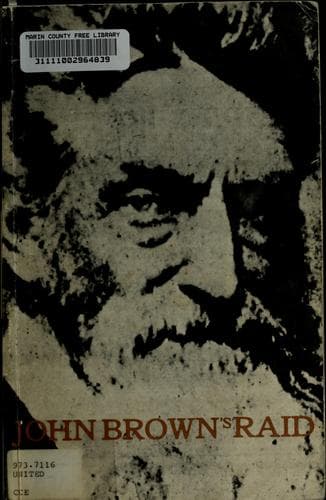
John Brown's RaidUnited States. National Park Service
History
John Brown's Raid
United States. National Park Service
Brown, John, 1800-1859; Harpers Ferry (W. Va.) -- History -- John Brown's Raid, 1859
Tidd and Stevens were followed by 22-year-old Albert Hazlett, another
veteran of the Kansas fighting, Canadian-born Stewart Taylor, and two
brothers from Iowa, Edwin and Barclay Coppoc. Hazlett had worked on his
brother’s farm in western Pennsylvania before joining Brown at the
Kennedy farm. He was totally committed to the overthrow of slavery. “I
am willing to die in the cause of liberty,” he said; “if I had ten
thousand lives I would willingly lay them all down for the same cause.”
Taylor, 23 years old, was once a wagonmaker. He had met Brown in Iowa in
1858 and was “heart and soul in the anti-slavery cause.” Scholarly, a
good debater, and “very fond of studying history,” Taylor, like Stevens,
was a spiritualist and had a premonition that he would die at Harpers
Ferry. The Coppocs were Quakers by birth and training. They were in
Kansas during the troubles there but took no part in the fighting.
Edwin, at 24, was 4 years older than his brother Barclay. Both had
joined Brown initially in 1858 at Springdale, Iowa, where they were
living with their mother, shortly before the Chatham Convention.
Twenty-year-old William H. Leeman arrived near the end of August. Born
and educated in Maine, he had worked in a Haverhill, Mass., shoe factory
before going to Kansas in 1856 where he served in Brown’s “Liberty
Guards” militia company. Impulsive, hard to control, the 6-foot-tall
Leeman “smoked a good deal and drank sometimes,” but he had “a good
intellect with great ingenuity.” Shortly before the raid he wrote his
mother that he was “warring with slavery, the greatest curse that ever
infected America. We are determined to strike for freedom, incite the
slaves to rebellion, and establish a free government. With the help of
God we will carry it through.”
After Leeman came Dangerfield Newby, a mulatto born a slave but freed by
his Scotch father, and Osborn P. Anderson, a 33-year-old free Negro who
had worked as a printer before joining Brown in Canada in 1858. Newby,
at 44 the oldest of the group save for Brown himself, had a wife and
several children in bondage in the South. He came to the Kennedy
farmhouse convinced that the only way to free them was with rifle and
bullet. Week after week he would read and reread a worn letter from his
wife in which she begged him to “Buy me and the baby, that has just
commenced to crawl, as soon as possible, for if you do not get me
somebody else will.”
Public-domain text, read in full here on John Shaqi.
Reviews
Reviews
No reviews yet
Be the first to share your thoughts on this work.
Join the Discussion
Join the discussion
Sign in to leave a comment or review.
Sign InorCreate an account