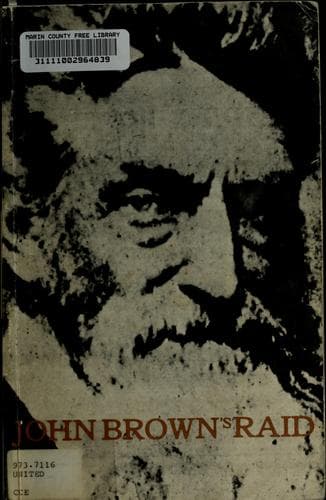
John Brown's RaidUnited States. National Park Service
History
John Brown's Raid
United States. National Park Service
Brown, John, 1800-1859; Harpers Ferry (W. Va.) -- History -- John Brown's Raid, 1859
JOHN BROWN’^S RAID
Through the gloom of the night, Sunday, October 16, 1859, a small band
of men tramped silently behind a horse-drawn wagon down a winding
Maryland road leading to Harpers Ferry, Va. From the shoulder of each
man hung loosely a Sharps rifle, hidden by long gray shawls that
protected the ghostly figures against the chilling air of approaching
winter. A slight drizzle of rain veiled the towering Blue Ridge
Mountains with an eerie mist. Not a sound broke the stillness, save the
tramping feet and the creaking wagon.
Side by side marched lawyer and farmer, escaped convict and pious
Quaker, Spiritualist and ex-slave, joined in common cause by a hatred of
slavery. Some had received their baptism of fire in “Bleeding Kansas,”
where a bitter 5-year war between pro-slavery and anti-slavery factions
left death and destruction in its wake and foreshadowed a larger
conflict to come. Most were students of guerrilla tactics; all were
willing to die to free the slaves.
This strange little force, five Negroes and 14 whites, was the
“Provisional Army of the United States,” about to launch a fantastic
scheme to rid the country of its “peculiar institution” once and for
all, a scheme conjured up by the fierce-eyed, bearded man seated on the
wagon—“Commander in Chief” John Brown. He was the planner, the
organizer, the driving force, the reason why these men were trudging
down this rough Maryland road to an uncertain fate.
THE ROAD TO HARPERS FERRY
This man who would electrify the Nation and bring it closer to civil war
by his audacious attack on slavery was born at Torrington, Conn., on May
9, 1800, the son of Owen and Ruth Mills Brown. The Browns were a simple,
frugal, and hard-working family. They had a deep and abiding interest in
religion, and from earliest childhood John Brown was taught the value of
strong religious habits. He was required, along with his brothers and
sisters, to participate in daily Bible reading and prayer sessions.
“Fear God & keep his commandments” was his father’s constant admonition.
It was also his father who taught him to view the enslavement of Negroes
as a sin against God.
[Illustration: Owen Brown]
[Illustration: The future abolitionist and martyr in the cause of
Negro freedom was born in this stark, shutterless farmhouse in
Torrington, Conn. He lived here only 5 years. In 1805 his father,
Owen Brown (above), sold the farm and moved the family west to
Ohio.]
Public-domain text, read in full here on John Shaqi.
Reviews
Reviews
No reviews yet
Be the first to share your thoughts on this work.
Join the Discussion
Join the discussion
Sign in to leave a comment or review.
Sign InorCreate an account