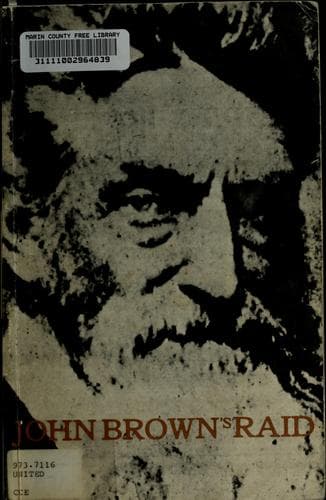
John Brown's RaidUnited States. National Park Service
History
John Brown's Raid
United States. National Park Service
Brown, John, 1800-1859; Harpers Ferry (W. Va.) -- History -- John Brown's Raid, 1859
In 1805 the Browns, like many other families of the period, moved west
to Ohio. There, in the little settlement of Hudson, about 25 miles south
of Cleveland, John grew to manhood. He received little formal education;
most of what he learned came from what he afterwards called the “School
of adversity.” He cared little for studies, preferring life in the open.
Consistently choosing the “hardest & roughest” kinds of play because
they afforded him “almost the only compensation for the confinement &
restraints of school,” he was extremely proud of his ability to
“wrestle, & Snow ball, & run, & jump, & knock off old seedy Wool hats.”
[Illustration: John Brown probably never saw a slave auction,
portrayed here in an illustration from the 1852 edition of Harriet
Beecher Stowe’s _Uncle Tom’s Cabin_, but his horror and hatred of
slavery made its destruction the “greatest or principle object” of
his life.]
When John was 8 years old his mother died, and for awhile he believed
that he would never recover from so “complete & permanent” a loss. His
father remarried, but John never accepted his stepmother emotionally and
“continued to pine after his own Mother for years.”
An indifferent student, and “not ... much of a schollar” anyway, John
quit school and went to work at his father’s tannery. Owen Brown, who
had been a tanner and a shoemaker before moving to Hudson, had already
taught his son the art of dressing leather from “Squirel, Raccoon, Cat,
Wolf, or Dog Skins,” and John soon displayed remarkable ability in the
trade. When the War of 1812 broke out, Owen contracted to supply beef to
the American forces in Michigan. He gave John the task of rounding up
wild steers and other cattle in the woods and then driving them, all by
himself, to army posts more than 100 miles away. Contact with the
soldiers and their profanity and lack of discipline so disgusted young
Brown that he later resolved to pay fines rather than take part in the
militia drills required of all Hudson males of a certain age.
It was during the war, or so Brown later claimed, that he first came to
understand what his father meant about the evil of slavery. He had just
completed one of his cattle drives and was staying with a “very
gentlemanly landlord” who owned a slave about the same age as John. The
Negro boy was “badly clothed, poorly fed ... & beaten before his eyes
with Iron Shovels or any other thing that came first to hand.” Outraged
by this, John returned home “a most determined Abolitionist” swearing
“Eternal war with Slavery.”
[Illustration: John Brown had not yet grown his famous beard when
this picture was taken in Kansas in 1856. Though 3 years away from
the deed that would make his name immortal, he had already begun his
private war against slavery.]
Public-domain text, read in full here on John Shaqi.
Reviews
Reviews
No reviews yet
Be the first to share your thoughts on this work.
Join the Discussion
Join the discussion
Sign in to leave a comment or review.
Sign InorCreate an account