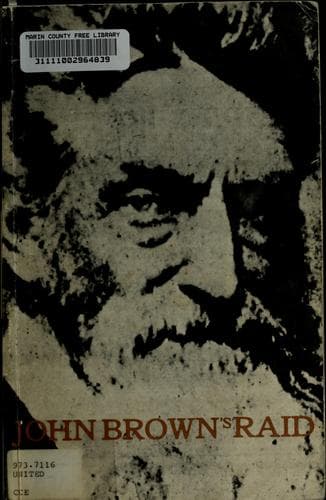
John Brown's RaidUnited States. National Park Service
History
John Brown's Raid
United States. National Park Service
Brown, John, 1800-1859; Harpers Ferry (W. Va.) -- History -- John Brown's Raid, 1859
By 7 a.m. there was enough light for operations. All arrangements for
the assault had been completed. The militia formed up outside the armory
wall to keep the street clear of spectators and to prevent
indiscriminate firing that might injure the storming party. The Marines
took position at the northwest corner of the enginehouse, just out of
the line of fire from the door. Then Lieutenant Stuart moved forward
with the surrender demand. Brown opened the door a few inches and placed
his body against the crack so the lieutenant could not see inside. He
held a cocked rifle in one hand. Stuart read the terms offered by Lee:
Colonel Lee, United States Army, commanding troops sent by the
President of the United States to suppress the insurrection at this
place, demands the surrender of the persons in the Armory buildings.
If they will peaceably surrender themselves and restore the pillaged
property, they shall be kept in safety to await the orders of the
President. Col. Lee represents to them, in all frankness, that it is
impossible for them to escape; that the Armory is surrounded on all
sides by troops; and that if he is compelled to take them by force he
cannot answer for their safety.
Robert E. Lee and J. E. B. Stuart are pictured here about the time
of the raid.
[Illustration: Robert E. Lee]
[Illustration: This little-known portrait of Stuart shows him in
civilian dress and with trimmed beard.]
According to Stuart, the parley was “a long one.” Brown refused to
surrender. Instead he presented his own propositions “in every possible
shape, and with admirable tact,” insisting that he, his men, and his
hostages be permitted to cross the river unmolested.
Stuart, instructed not to accept any counter-proposals, sensed that
further discussion was useless. Stepping back from the door, he waved
his hat, a pre-arranged signal for the Marines to attack. Brown slammed
the door shut and the troops came on. Three men with sledge hammers
pounded the center door of the enginehouse, but it would not yield; the
raiders had placed the fire engines against it. Spotting a heavy ladder
nearby, Lieutenant Green directed his men to use it as a battering-ram.
On the second blow the door splintered and a small opening was effected.
[Illustration: Lt. Israel Green led the Marine attack on the
enginehouse and was the first man to enter the building.]
[Illustration: The engraving below shows the Marines battering the
enginehouse door while under fire from raiders inside.]
Lieutenant Green was the first man through. Maj. W. W. Russell, armed
only with a rattan cane, followed immediately. Pvt. Luke Quinn squeezed
through behind Russell and fell dead at the door, shot through his
groin. Another Marine, Pvt. Mathew Ruppert, stepped over Quinn, then
dropped his gun and clawed his face in pain where a bullet had torn
through his cheek. The rest of the storming party entered without
injury.
Public-domain text, read in full here on John Shaqi.
Reviews
Reviews
No reviews yet
Be the first to share your thoughts on this work.
Join the Discussion
Join the discussion
Sign in to leave a comment or review.
Sign InorCreate an account