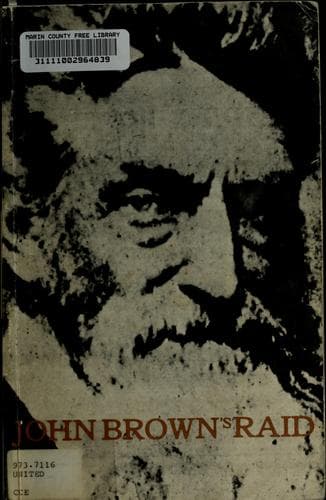
John Brown's RaidUnited States. National Park Service
History
John Brown's Raid
United States. National Park Service
Brown, John, 1800-1859; Harpers Ferry (W. Va.) -- History -- John Brown's Raid, 1859
The hostages cowered at the rear of the building; Brown knelt between
the fire engines, rifle in hand. As Green came through the row of
engines, Colonel Washington greeted him and pointed at Brown. Green
raised his sword and brought it down with all his strength, cutting a
deep wound in the back of the raider chieftain’s neck. As Brown fell,
Green lunged with his sword, striking part of the raider’s accouterments
and bending the blade double. Green then showered blow after blow upon
Brown’s head until he fell unconscious. Two of the raiders were killed
almost immediately after the Marines entered the building: Dauphin
Thompson, pinned against the rear wall by a bayonet, and Jeremiah
Anderson, run through by a saber as he sought refuge under one of the
fire engines. Edwin Coppoc and Shields Green surrendered. The fight was
over in about 3 minutes.
[Illustration: After their capture, Brown and his surviving men were
placed under guard outside the enginehouse, where they were
subjected to taunts and threats of angry militia and townspeople.]
None of the hostages was injured, although Lieutenant Green considered
them the “sorriest lot of people I ever saw.” The dead, dying, and
wounded raiders were carried outside and laid in a row on the grass. As
Brown slowly regained consciousness, the Marines had trouble keeping
back the throngs of militia and townspeople who wanted to see the
wounded raider leader. After noon, Brown and Stevens, still suffering
from the wounds he received on October 17, were carried to the
paymaster’s office where a group of inquisitors, including Virginia’s
Governor Henry A. Wise and Senator James M. Mason, and Ohio Congressman
Clement L. Vallandigham, questioned them for 3 hours in an effort to
learn their purpose and the names of their supporters in the North.
During the interrogation Brown lay on the floor, his hair matted and
tangled, his face, hands, and clothes soiled and smeared with blood. He
talked freely, and while he readily admitted his intention to free the
slaves, “and only that,” he refused to divulge the names of his Northern
backers. “No man sent me here,” he said; “it was my own prompting and
that of my Maker, or that of the devil, whichever you ascribe it to. I
acknowledge no man in human form.” He continued:
I want you to understand, gentlemen ... that I respect the rights of
the poorest and weakest of colored people, oppressed by the slave
system, just as much as I do those of the most wealthy and powerful.
That is the idea that has moved me, and that alone. We expect no
reward, except the satisfaction of endeavoring to do for those in
distress and greatly oppressed, as we would be done by. The cry of
distress of the oppressed is my reason, and the only thing that has
prompted me to come here.
Brown then issued a prophetic warning:
Public-domain text, read in full here on John Shaqi.
Reviews
Reviews
No reviews yet
Be the first to share your thoughts on this work.
Join the Discussion
Join the discussion
Sign in to leave a comment or review.
Sign InorCreate an account