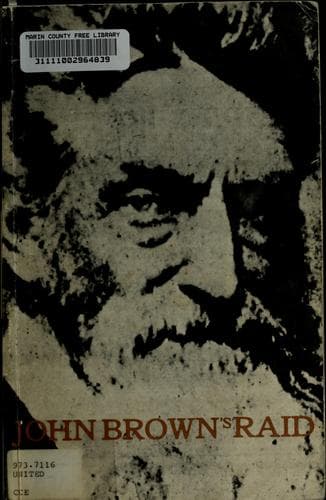
John Brown's RaidUnited States. National Park Service
History
John Brown's Raid
United States. National Park Service
Brown, John, 1800-1859; Harpers Ferry (W. Va.) -- History -- John Brown's Raid, 1859
A few minutes after 11 a.m. on December 2, 1859, John Brown walked down
the steps of the Charles Town jail, climbed into the back of a
horse-drawn wagon, and sat down on his own coffin. Flanked by files of
soldiers, the wagon moved off toward a field a short distance from the
town where a scaffold had been erected. No civilians were permitted near
the execution site. The field was ringed by 1,500 soldiers, among them a
company of Virginia Military Institute cadets commanded by a
stern-looking professor who would soon gain fame and immortality as the
Confederate Gen. “Stonewall” Jackson. In the ranks of a Richmond company
stood another man who, in a few short years, would also achieve
immortality by committing one of the most infamous deeds in American
history—John Wilkes Booth.
[Illustration: With soldiers lining the streets, John Brown comes
down the steps of the Charles Town jail on the way to his execution,
December 2, 1859. The wagon containing his coffin stands nearby.]
As the hushed military watched, Brown climbed the scaffold steps.
Sheriff John W. Campbell pulled a white linen hood over the prisoner’s
head and set the noose. John Avis, the jailer, asked Brown to step
forward onto the trap. “You must lead me,” Brown replied, “for I cannot
see.” The abolitionist’s last words were directed to Avis as one final
adjustment of the noose was made. “Be quick,” he said.
At 11:30 a hatchet stroke sprung the trap and John Brown died. The voice
of a militia colonel broke the stillness: “So perish all such enemies of
Virginia! All such enemies of the Union! All such enemies of the human
race!”
But the end was not yet. True, Brown was dead; but he had helped to
arouse popular passions both North and South to the point where
compromise would be impossible. The raid created a national furor and
generated a wave of emotionalism that widened the sectional breach that
had divided the country for so many years. Although conservative
Northern opinion quickly condemned the raid as the work of a madman, the
more radical hailed it as “the best news America ever had” and glorified
Brown as “the new saint” whose martyrdom in the cause of human freedom
would make the gallows “glorious like the cross.”
[Illustration: The hanging of John Brown took place at 11:30 a.m.,
December 2, 1859, in a field just outside Charles Town. The field no
longer exists, but the site is identified by a simple stone marker.]
Public-domain text, read in full here on John Shaqi.
Reviews
Reviews
No reviews yet
Be the first to share your thoughts on this work.
Join the Discussion
Join the discussion
Sign in to leave a comment or review.
Sign InorCreate an account