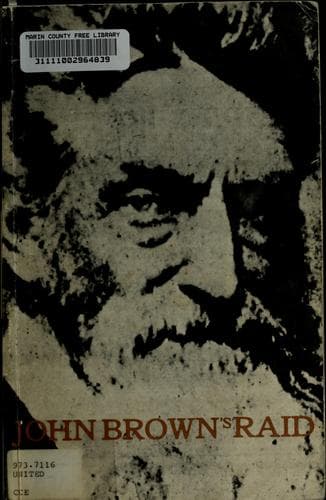
John Brown's RaidUnited States. National Park Service
History
John Brown's Raid
United States. National Park Service
Brown, John, 1800-1859; Harpers Ferry (W. Va.) -- History -- John Brown's Raid, 1859
Southerners shuddered. For decades they had been defending their
“peculiar institution” of slavery against the ever-increasing attacks of
Northern abolitionists, but anti-slavery agitation had always followed a
course of non-violence. Then Brown had come with his pikes and guns to
change all that. In the false atmosphere of crisis that gripped the
South in the wake of the raid, the small voices of moderates were lost
in the din of extremists who saw Brown’s act as part of a vast Northern
conspiracy to instigate servile insurrections throughout the slave
States.
To meet this threat, real or imagined, vigilance committees were formed,
volunteer military companies were organized, and more and more
Southerners began to echo the sentiments of the Richmond Enquirer: “if
under the form of a Confederacy our peace is disturbed, our State
invaded, its peaceful citizens cruelly murdered ... by those who should
be our warmest friends ... and the people of the North sustain the
outrage, then let disunion come.”
Disunion sentiment increased during the presidential campaign of 1860,
stimulated by a split in the Democratic Party that practically
guaranteed a Republican victory in the November elections. When Abraham
Lincoln was elected President, the secessionist movement could no longer
be contained. On December 20, unable to tolerate a President “whose
opinions and purposes are hostile to slavery,” South Carolina severed
her ties with the Union. By February 1, 1861, Mississippi, Florida,
Alabama, Georgia, Louisiana, and Texas had followed her lead. One week
later the Confederate States of America was formed at Montgomery, Ala.,
and the country drifted slowly toward civil war. Before many months had
passed, soldiers in blue would be marching south to the tune of “John
Brown’s Body” as if to fulfill the prophecy Brown had left in a note to
one of his Charles Town guards shortly before the execution:
[Illustration: Charlestown, Va, 2^d, december, 1859 I John Brown am
now quite certain that the crimes of this guilty, land: will never
be purged away; but with Blood. I had as I now think: vainly
flattered myself that without very much bloodshed; it might be
done.]
EPILOGUE
The war that John Brown predicted would come, and which his raid helped
to precipitate, began in April 1861. When it ended almost 4 years to the
day later, slavery had been destroyed along with some 600,000 lives and
millions of dollars worth of property. Among the casualties of the war
was Harpers Ferry. The town’s strategic position on the Baltimore and
Ohio Railroad at the northern end of the Shenandoah Valley made it a
prime target for both Union and Confederate forces. It changed hands
again and again, and by war’s end in 1865 the place was a shambles.
Public-domain text, read in full here on John Shaqi.
Reviews
Reviews
No reviews yet
Be the first to share your thoughts on this work.
Join the Discussion
Join the discussion
Sign in to leave a comment or review.
Sign InorCreate an account