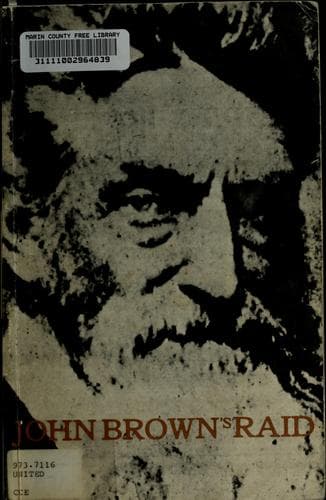
John Brown's RaidUnited States. National Park Service
History
John Brown's Raid
United States. National Park Service
Brown, John, 1800-1859; Harpers Ferry (W. Va.) -- History -- John Brown's Raid, 1859
The ruins of the armory buildings stood for many years after the war and
eventually disappeared. In 1893 the site itself disappeared under 30
feet of fill when the B & O Railroad changed the line of its tracks. The
outlines of two of the armory buildings have been marked by flat stones
and the spot where the enginehouse was located is marked by a small
monument. The enginehouse itself (now called “John Brown’s Fort”) stands
nearby on the old arsenal grounds, and is little changed from its
appearance at the time of the raid. Here also can be seen the excavated
remains of the small U.S. arsenal and some of the partially exposed
burned muskets destroyed when the building was gutted by Federal troops
in April 1861.
In February 1862 Federal soldiers burned the Point area of Harpers Ferry
to keep Confederate sharpshooters from using the buildings. Among the
structures destroyed were the railroad depot, the water tower around
which Mayor Fontaine Beckham was peering when he was shot by one of the
raiders, several stores and shops, the Potomac Restaurant, the Wager
House Hotel, and the Gault House Saloon. The Wager House (not to be
confused with another structure of the same name that still exists) was
the scene of several notable events. It was here that many of the
wounded were carried, including two of the raiders, Aaron Stevens and
William Thompson. Many of the militiamen did their “best fighting” at
its bar. From the Wager House porch, Gov. Henry Wise of Virginia read
letters taken from Brown’s men to the angered townspeople. Wise also
lived here during his brief stay in Harpers Ferry. Mrs. John Brown
stayed here when she came to Harpers Ferry in December 1859 for her last
visit with her husband, and it was here that she received his body after
the execution.
The Shenandoah islands are deserted today except for the line of the
Winchester and Potomac Railroad. All of the buildings are gone now
except for the foundations of some of the mills and the retaining walls
of the rifle factory, nestled in among the weeds, brush, and trees. Many
disappeared through neglect after the industries were destroyed during
the Civil War, some washed away in the many floods with which Harpers
Ferry has been plagued, and others, like Herr’s flour mill and the rifle
works, were deliberately destroyed by Union and Confederate troops.
Public-domain text, read in full here on John Shaqi.
Reviews
Reviews
No reviews yet
Be the first to share your thoughts on this work.
Join the Discussion
Join the discussion
Sign in to leave a comment or review.
Sign InorCreate an account