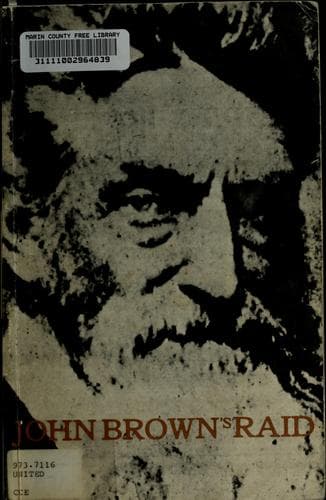
John Brown's RaidUnited States. National Park Service
History
John Brown's Raid
United States. National Park Service
Brown, John, 1800-1859; Harpers Ferry (W. Va.) -- History -- John Brown's Raid, 1859
In 1861 the people in the mountainous western counties of Virginia
strongly opposed secession. When the rest of the State voted
overwhelmingly in a statewide referendum on May 23, 1861, to withdraw
from the Federal Union, the loyal western residents, in a series of
conventions at Wheeling, voted to “secede” from Virginia and set up
their own State. The bill for admission passed Congress on December 11,
1862, and on June 30, 1863, by Presidential proclamation, West Virginia
became the 35th State. For years, however, many Jefferson County
residents refused to use “West” as part of the designation.
Harpers Ferry never recovered from the devastation of the Civil War.
Staring at the stark chimneys and charred remains of once impressive
buildings, one of the townspeople concluded: “This place will never be
anything again unless the government rebuilds the armory—and it is
doubtful if that is ever done.” The Government never did, and the ground
on which it stood was auctioned off in 1869. Mills and factories
remained closed. The railroad did a small percentage of its previous
business. Hopes for a renewal of the town’s former prosperity were
dashed in 1870 when a flood destroyed or badly damaged nearly every
building on Virginius Island and along the south side of Shenandoah
Street. Subsequent floods destroyed still more of the town and ruined
the Chesapeake and Ohio Canal. The canal was finally abandoned after the
flood of 1924.
Inundated too often by high water, the residents of Harpers Ferry
eventually left the old buildings in the lower town and moved up the
heights to the high ground of Camp Hill and toward Bolivar. For years
the old shops and stores, those that remained, stood empty, neglected,
and deteriorating. When Harpers Ferry became a national historical area,
the National Park Service began an intensive campaign to preserve the
fragile remains of the 18th- and 19th-century industries, homes,
churches, stores, and shops, and to restore much of the old town to its
pre-Civil War appearance, a time when it was at its peak as a thriving,
bustling industrial community and transportation center.
Today, while much of the old historical town remains, few of the
structures that figured prominently in John Brown’s raid survive. (See
maps on pp. 29 and 30.) The Baltimore and Ohio Railroad bridge across
the Potomac, by which Brown and his raiders entered Harpers Ferry in
October 1859, was destroyed by Confederate soldiers early in the Civil
War. More modern structures span the river now, but the stone supports
of the old bridge can still be seen. Nothing at all remains of the
bridge across the Shenandoah. The stone piers now standing in the river
near the Point section of the town are from a later structure.
Public-domain text, read in full here on John Shaqi.
Reviews
Reviews
No reviews yet
Be the first to share your thoughts on this work.
Join the Discussion
Join the discussion
Sign in to leave a comment or review.
Sign InorCreate an account