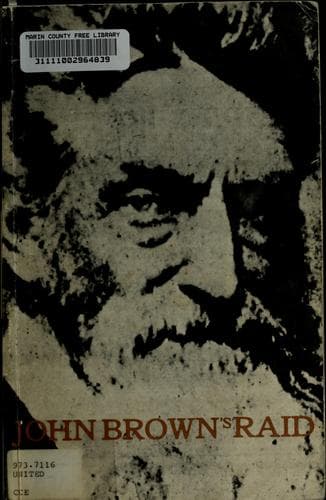
John Brown's RaidUnited States. National Park Service
History
John Brown's Raid
United States. National Park Service
Brown, John, 1800-1859; Harpers Ferry (W. Va.) -- History -- John Brown's Raid, 1859
Five of Brown’s sons—Owen, Jason, Frederick, Salmon, and John, Jr.—had
emigrated to Kansas and joined the free-soil cause. When they appealed
to their father for help in May 1855, Brown, another son Oliver, and
son-in-law Henry Thompson rushed to Kansas and plunged into the conflict
with a fury. As captain of the “Liberty Guards,” a quasi-militia company
that he himself formed, Brown shortly gained national notoriety as a
bold and ruthless leader.
For the next several years, murders, bushwhackings, lynchings, and
burnings were common occurrences, and the territory was aptly named
“Bleeding Kansas.” Atrocity matched atrocity. When pro-slavery forces
sacked and burned the town of Lawrence in May 1856, Brown was outraged.
Proclaiming himself an instrument of God’s will, he, with four of his
sons and three others, deliberately and brutally murdered five
pro-slavery men along the banks of Pottawatomie Creek. In the months
that followed, Brown terrorized the Missouri-Kansas border by a series
of bloody guerrilla attacks that brought him to the attention of the
Nation’s abolitionist faction. In late August 1856, about a month before
he left Kansas, Brown and his men clashed with pro-slavery Missourians
at the small settlement of Osawatomie. That action earned him the
nickname “Osawatomie” and cost him the life of his son Frederick. It
also hardened his stand against slavery. “I have only a short time to
live—only one death to die,” he said, “and I will die fighting for this
cause. There will be no more peace in this land until slavery is done
for. I will give them something else to do than to extend slave
territory. I will carry this war into Africa.”
Three of John Brown’s most trusted lieutenants in the Harpers Ferry
raid:
[Illustration: John E. Cook]
[Illustration: Aaron D. Stevens]
[Illustration: John H. Kagi]
The attack on Harpers Ferry was the culmination of a plan Brown had
evolved many years before he went to Kansas. By the early 1850’s he had
come to believe that a location within the slave States should be
selected where raids on slave plantations could be easily carried out
and the freed bondsmen sent to safety in the North. Convinced that
mountains throughout history had enabled the few to defend themselves
against the many, he believed that even against regular Army troops a
small force operating from a mountain stronghold could hold out
indefinitely and provide sanctuary for freed slaves, who would be
supplied with arms to fight for their liberty. Brown had decided, from
studying European fortifications and military operations, that somewhere
along the Allegheny Mountain chain a small force could achieve those
objectives.
Public-domain text, read in full here on John Shaqi.
Reviews
Reviews
No reviews yet
Be the first to share your thoughts on this work.
Join the Discussion
Join the discussion
Sign in to leave a comment or review.
Sign InorCreate an account