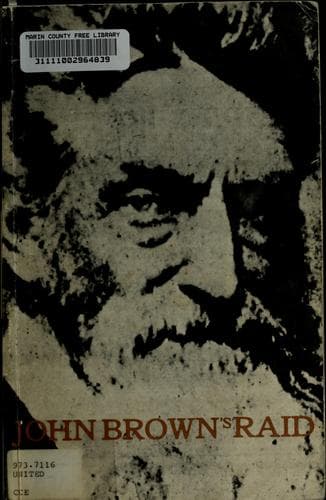
John Brown's RaidUnited States. National Park Service
History
John Brown's Raid
United States. National Park Service
Brown, John, 1800-1859; Harpers Ferry (W. Va.) -- History -- John Brown's Raid, 1859
[Illustration: Mary Ann Day, Brown’s loyal and self-sacrificing
second wife, stoically endured her husband’s constant wanderings in
business and anti-slavery activities. She is shown here about 1851
with two of their daughters, Annie and Sarah.]
In 1816 John joined the Congregational Church in Hudson and soon
developed a strong interest in becoming a minister. For a while he
attended a divinity school in Plainfield, Mass., then transferred to
another school in Litchfield, Conn. At that time Litchfield was a center
of abolitionist sentiment; it was also the birthplace of Harriet Beecher
Stowe, whose book _Uncle Tom’s Cabin_, published in 1852, would stir
passions North and South, win international support for the anti-slavery
cause, and help to bring on civil war in 1861. How much of Litchfield’s
abolitionist atmosphere young Brown absorbed is not known. A shortage of
funds and an inflammation of the eyes forced him to return to Ohio in
the summer of 1817. His dream of becoming a minister was forever
shattered, but he never lost his religious fervor.
When he was 20 years old, “led by his own inclination & prompted also by
his Father,” Brown married Dianthe Lusk, a “remarkably plain” and pious
girl a year younger than himself. She died 12 years later, in August
1832, following the birth of their seventh child. Brown remarried within
a year, and fathered 13 children by his second wife, Mary Ann Day. In a
never-ending struggle to feed and clothe his growing family, Brown
drifted through Ohio, Pennsylvania, New York, Connecticut, and
Massachusetts plying many trades. He worked at tanning, surveying, and
farming; at times he was shepherd, cattleman, wool merchant, and
postmaster; for a while he bred race horses and speculated in real
estate. Uniformly unsuccessful in these ventures, Brown’s debts mounted,
and he was barely able to keep his large family from starvation.
Despite his frequent business reversals and his strenuous and consuming
efforts to support his family, Brown never abandoned his intense desire
to free enslaved Negroes from bondage. His first opportunity to strike a
blow at the institution he hated so much came in Kansas, where,
following the passage of the Kansas-Nebraska Act in 1854, pro-slavery
“Border Ruffians” clashed brutally with anti-slavery “Jayhawkers” over
the extension of slavery to Kansas and Nebraska Territories.
[Illustration: John Brown, Jr., the oldest of Brown’s sons, fought
alongside his father in Kansas. The Pottawatomie murders, in which
he took no part, caused him to suffer a mental collapse from which
he never fully recovered. Nevertheless, in 1859 he was entrusted
with forwarding the weapons for the attack on Harpers Ferry from
Ohio to Chambersburg, Pa.]
Public-domain text, read in full here on John Shaqi.
Reviews
Reviews
No reviews yet
Be the first to share your thoughts on this work.
Join the Discussion
Join the discussion
Sign in to leave a comment or review.
Sign InorCreate an account