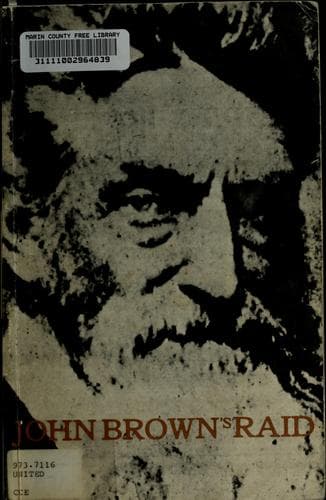
John Brown's RaidUnited States. National Park Service
History
John Brown's Raid
United States. National Park Service
Brown, John, 1800-1859; Harpers Ferry (W. Va.) -- History -- John Brown's Raid, 1859
After a trip to New England to raise funds, Brown called a
“Constitutional Convention” of his followers to meet on May 8, 1858, at
Chatham, Ontario, Canada. Besides Brown’s group, 34 Negroes attended the
meeting and heard the Kansas guerrilla chieftain outline his plan for
the deliverance of their enslaved brethren. First, he told them, he
intended to strike at a point in the South. This blow would be followed
by a general slave uprising in which even free Negroes in the Northern
States and Canada would flock to his banner. He would lead them into the
mountains and “if any hostile action ... were taken against us, either
by the militia of the separate States or by the armies of the United
States, we purposed to defeat first the militia, and next, if it were
possible, the troops of the United States....”
The convention unanimously adopted a “Provisional Constitution and
Ordinances for the People of the United States” to serve as the law of
the land while the army of liberation instituted a new government—one
that would not supplant but exist side-by-side with the U.S. Government
and which would explicitly prohibit slavery. John Brown was elected
“Commander in Chief” of the new provisional army to be formed, other
officers were appointed, and the convention adjourned. Before leaving
again for New England to gather supplies and money for the attack, Brown
sent Cook to Harpers Ferry to act as a spy; the others scattered,
seeking employment to maintain themselves until called together for the
march into Virginia.
The moral and financial backing of these men, known as “The Secret
Six,” made the raid on Harpers Ferry possible.
[Illustration: Samuel Gridley Howe]
[Illustration: Thomas Wentworth Higginson]
[Illustration: Franklin B. Sanborn]
[Illustration: George Luther Stearns]
[Illustration: Gerrit Smith]
[Illustration: Theodore Parker]
To equip, maintain, and transport the men needed to carry out his plan,
Brown required a considerable amount of money and weapons. He had
neither, but because of his Kansas activities, he was able to enlist the
support of Northern abolitionists in his fight against slavery.
Philosophers, scholars, religious leaders, philanthropists, and
businessmen gave freely but discreetly to the cause. Chief among Brown’s
backers was a secret committee of six: Dr. Samuel Gridley Howe, Boston,
Mass., educator, minister, and reformer; Thomas Wentworth Higginson,
militant clergyman of Worcester, Mass.; Theodore Parker, Boston’s
outstanding Unitarian minister; Franklin B. Sanborn, editor and
schoolmaster of Concord, Mass.; Gerrit Smith, former New York
Congressman and a great Peterboro, N.Y., landowner; and George L.
Stearns, industrialist and merchant of Medford, Mass. Through them Brown
received most of the money and weapons that enabled him to launch his
attack.
RENDEZVOUS FOR REVOLUTION
Public-domain text, read in full here on John Shaqi.
Reviews
Reviews
No reviews yet
Be the first to share your thoughts on this work.
Join the Discussion
Join the discussion
Sign in to leave a comment or review.
Sign InorCreate an account