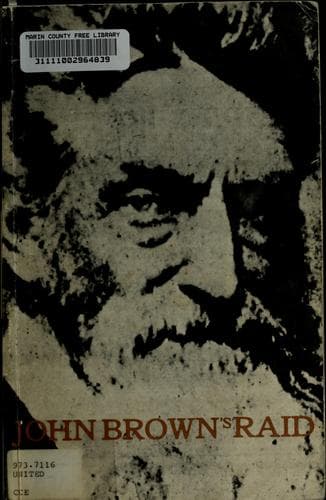
John Brown's RaidUnited States. National Park Service
History
John Brown's Raid
United States. National Park Service
Brown, John, 1800-1859; Harpers Ferry (W. Va.) -- History -- John Brown's Raid, 1859
By the summer of 1859 Harpers Ferry was a quietly thriving little
industrial and transportation community sitting on a narrow shelf of
land at the confluence of the Potomac and Shenandoah Rivers in the Blue
Ridge Mountains of northern Virginia. Until its selection as the site
for a Federal armory at the end of the 18th century, the town’s growth
had been slow. What growth it did experience was due to its location on
the wilderness route to the Shenandoah Valley. The land on which the
town sat was first settled in 1733 by a Pennsylvania Dutchman named
Peter Stephens, who operated a small ferryboat service across the
rivers. At that time the place was called “Peter’s Hole” because it was
dominated by three towering bluffs—Maryland Heights to the north,
Loudoun Heights to the south, and Bolivar Heights to the west. When
Robert Harper, a skilled Philadelphia architect and millwright, bought
the land in 1747, he improved the ferry service and built a gristmill.
Around these facilities at the base of Bolivar Heights the village of
Harpers Ferry gradually developed.
In 1794, when relations between the United States and England were
strained, Congress grew uneasy over the country’s military posture.
Uncertain of the ordnance-producing capabilities of private
manufacturers in time of need, it directed President George Washington
to establish a number of armories where guns could be made and stored.
One of the sites he chose was Harpers Ferry.
Washington was well acquainted with Harpers Ferry. As a young man during
the middle part of the century, he had accompanied surveying parties
that inspected the vast holdings of the Virginia aristocracy in this
area. He considered Harpers Ferry “the most eligible spot on the
[Potomac] river” for an armory. Abundant water power was available, iron
ore was plentiful nearby, hardwood forests insured a steady supply of
charcoal to fuel the forges, and the place was far enough inland to be
secure from foreign invasion.
In June 1796 the Government purchased from the Harper heirs a 125-acre
tract of land and began constructing workshops on the benchland between
the Potomac River and what would later become Potomac Street. Waterpower
was harnessed by building a dam upstream from the armory and channeling
the water through a canal into the workshops. Although a critical
shortage of gunsmiths and ordnance-making machinery restricted
operations for several years, limited arms production began late in 1798
under the direction of an English Moravian named Joseph Perkin, the
armory’s first superintendent.
Public-domain text, read in full here on John Shaqi.
Reviews
Reviews
No reviews yet
Be the first to share your thoughts on this work.
Join the Discussion
Join the discussion
Sign in to leave a comment or review.
Sign InorCreate an account