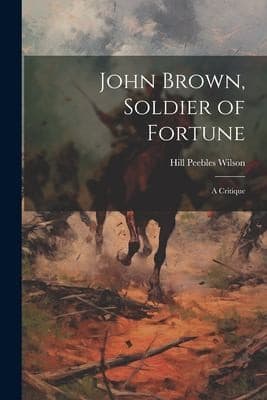
John Brown, Soldier of Fortune: A CritiqueWilson, Hill Peebles
History
John Brown, Soldier of Fortune: A Critique
Wilson, Hill Peebles
Brown, John, 1800-1859
If this author had redeemed the pledge which he solemnly gave to the
public, to put forth the truths of history as far as ascertainable, and,
judging Brown and his followers in the light of them, had justified his
"terrible violation of the statute and moral laws," the nature of this
criticism would be different; it would be directed against his
discrimination or, perhaps, against his intelligence. But that is not
the case. The author referred to has sifted the truths of this history,
and from the fragments has framed an hypothetical case; and has judged
Brown and his followers in the light of that creation. "How may the
killings on the Pottawatomie, this terrible violation of the statute and
the moral law be justified? This is the question that has confronted
every student of John Brown's life since it was definitely established
that Brown was, if not actually a principal in the crime, an accessory
and an instigator,"[5] is not the language of an impartial historian;
but it is consistently the language of an advocate who writes for a
specious, for an ulterior purpose. Why should an historian seek to
justify a crime? Why should this author, if he intended to write
impartially, seek for evidence to justify this horror? It was the desire
to justify the crime that impelled the author to seek for pretexts for
justification of it among the surviving criminals, and to garble the
historical facts concerning it.
The crime was the theft of a large number of horses; to accomplish it,
and to safeguard the loot, it was necessary to kill the owners thereof.
It was a premeditation. The plans for it were laid several weeks before
it was executed, and during a time of profound peace. The principals
were John Brown; his unmarried sons; Henry Thompson, his son-in-law;
Theodore Weiner, and four confederates: Jacob Benjamin, B. L. Cochrane,
John E. Cook and Charles Lenhart, whose names are herein associated with
this crime for the first time in history. These confederates received
from Brown's party the horses which belonged to the men whom they
murdered, and ran them out of the country; leaving with Brown a number
of horses, "fast running horses," which they had stolen in the northern
part of the Territory. That is the crime which this author seeks to
justify; he has concealed these truths, and has suppressed the evidence
concerning them. Pretending to put forth the "exact facts as to the
happenings on the Pottawatomie," he has suppressed the evidence
concerning the most important of the happenings, and has added no
material fact concerning them which James Townsley had not, years
before, put forth in his confession.
Public-domain text, read in full here on John Shaqi.
Reviews
Reviews
No reviews yet
Be the first to share your thoughts on this work.
Join the Discussion
Join the discussion
Sign in to leave a comment or review.
Sign InorCreate an account