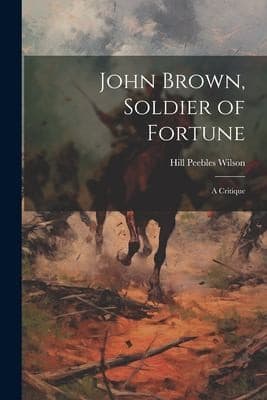
John Brown, Soldier of Fortune: A Critique — John Shaqi
John Brown, Soldier of Fortune: A CritiqueWilson, Hill Peebles
History
John Brown, Soldier of Fortune: A Critique
Wilson, Hill Peebles
Brown, John, 1800-1859
Mr. Villard's treatment of the Pottawatomie incident, "without a clear
appreciation of which a true understanding of Brown, the man, cannot be
reached,"[10] must stand as an indictment, either of his discrimination
or of the integrity of his purpose, concerning it. Not being a dull man,
he could not have been imposed upon by the participants in this riot of
robbery and blood whom he interviewed, and whose evasions he has
certified to the world as the exact facts. It was not the happenings on
the night of May 24, 1856, that determine "the degree of criminality, if
any," [mark the language, _if any_] "that should attach to Brown, for
his part in the proceedings,"[11] for they were but the execution of the
plans which had theretofore been laid for the adventure. Whatever the
circumstances of the author's dereliction may have been, the fact
remains, that the truths concerning this historical episode have been
sifted, and such documents and concurrent evidence as tend to establish
the fact that the motive for these murders was robbery, have been
consistently suppressed from his exposition of it.
Brown made no attempt to justify his conduct in the affair. He would
have acknowledged his responsibility and would have pleaded
justification for his acts, if there had been even a shadow of a pretext
for any justification; for he was shifty and crafty as well as vain; and
was sensitive concerning his reputation.[12] Not having the murdered
men's horses in his possession, he denied his complicity with the
murders, denied that he was concerned in the crime. If he had "killed
his men" (and stolen their horses) "in the conscientious belief that he
was a faithful servant of Kansas and of the Lord," as this author
asserts, he would not have denied his relationship with the Lord in the
matter, and offended Deity by persistently denying his participation in
it with Him; neither would he have abandoned Kansas and the Free-State
cause within the ensuing sixty days. Cowardly midnight robbery is
impossible of justification upon any ordinary circumstantial hypothesis;
and is preëminently so when the crime is aggravated by brutal
assassinations, such as were incidental to this wholesale theft of
horses.
Public-domain text, read in full here on John Shaqi.
Reviews
Reviews
No reviews yet
Be the first to share your thoughts on this work.
Join the Discussion
Join the discussion
Sign in to leave a comment or review.
Sign InorCreate an account